
tl;dr: The Silicon Valley Film Fund is funding the next great cinematic works on the technology industry. Our first grant will be a $15,000 award to a filmmaker who wants to make a short film. The fund’s short-term goal is to jump-start a new film industry in San Francisco, its medium-term goal is to train a new generation of tech-native writers, directors, and producers, and its long-term goal is to shepherd a theatrically successful film into theaters. We have no portfolio. We have no agenda. Our agenda is the culture’s. Submission criteria can be found below. Submit your script to scripts@svfilm.fund. We will review every script.
We Need Better Stories
Silicon Valley tech is one of the most culturally dominant forces in the world. It has reshaped how humans work, communicate, relate to each other, and understand themselves. The founders, engineers, and builders of this world have changed civilization. And yet there is almost no serious cinema that comes from inside it.
Not caricature. Not satire. Not outsider reconstruction. Genuine interior cinema — stories told by people who lived inside the industry, built in it, and have been shaped by it. And the window to make it is open right now. AI has made building so accessible, and the industry’s implications so far-reaching and consequential, that those building now have the time, and are forced, to look up and ask: why are we building?
Here is the current film canon for the innovation industry:
cinema
The Social Network (2010): 15 years old, zeitgeist story (Facebook), explores high-level themes of obsession, disconnection from reality, and betrayal. Shaped by David Fincher & Aaron Sorkin. Canonical cinema. This is the best portrait of startup life we have.
Her (2013): Technology filling human voids. Isolation. A specific modern loneliness. Strong touchpoint, but ultimately observational.
Steve Jobs (2015): Biopic. A single person and snapshot in time.
BlackBerry (2023): The rise and fall of RIM. A portrait of founders and a company in real time. But, it’s a documented story working from a historical scaffold.
Pirates of Silicon Valley (1999): A TV movie. Also on Steve Jobs & Bill Gates.
Artificial (coming soon, 2026): Sam Altman’s 2023 ousting from OpenAI, another zeitgeist, point-in-time story.
Jason Carman is working on a sci-fi trilogy (coming soon, 2026-2027)
documentary
New Space (2025): Jason Carman’s first feature-length documentary.
Too Cheap To Meter (2025): Jason Carman’s second feature-length documentary.
General Magic (2018): Close to interiority. A retrospective.
The Inventor: Out for Blood in Silicon Valley (2019): Theranos. Elizabeth Holmes. Observational.
Lo and Behold (2016): Herzog treats Silicon Valley as an alien civilization to observe. Fascinating. Not interior.
The Internet’s Own Boy (2014): Aaron Swartz. A martyr’s portrait. Not a world.
Something Ventured (2011): Founders celebrating themselves. Hagiography dressed as history.
The AI Doc: Or How I Became an Apocaloptimist (coming this month, March 2026): The inevitable “regular guy trying to figure out what is going on” documentary. From trailer, looks like it will be a balanced, high-level account. A handful of expert interviews, equal parts fear and equal parts optimism. A perspective that should exist. Still not from inside this world.
television
Silicon Valley (2014–2019): Satire. Brilliant. Keeps the world at arm’s length by design.
Halt and Catch Fire (2014–2017): Period reconstruction. 1980s tech. Interior but historical.
WeCrashed / The Dropout / Super Pumped (2022): The scandal wave. Fraud as prestige TV.
Black Mirror: Tech anxiety from the outside. British. Speculative.
The Audacity (coming soon, April 2026): From the trailer looks like more outsider reconstruction with dramatic license.
Biopics about legends, documentaries about fraud, a TV movie, one Herzog oddity, a 15-year-old film made by two geniuses who weren’t from this world, and a timely AI documentary. Seven decades of building the most consequential technology in human history, and this is the only cinematic record that exists of this industry.
Compare this with the finance industry, just looking at cinema: Wall Street (1987), Rogue Trader (1999), Boiler Room (2000), Too Big to Fail (2011), Margin Call (2011), The Wolf of Wall Street (2013), The Big Short (2015). A rich canon of seven films spanning four decades from multiple perspectives. Greed, collapse, moral compromise, human cost.
A thorough cinematic rendering of a world.
Why This Matters Now
Storytelling is the transmission of experience. Cinema defines collective memory. It is the only medium that can make you feel another person’s interior life in your body. It is the antidote to cultural misunderstanding. It is the ultimate unifier. Eras are processed & remembered through the films made about them.
We don’t need to make better films about ourselves in the same way that we don’t need great art. It’s not imperative to our life or death. To this working or that working. But the greatest works of film, the greatest works of art, make it hard to imagine life without them. And you only know after they exist.
When inside the tech Twitter bubble, it’s hard to see that we’re in an era worth documenting cinematically. A time-period where the work this geographic region produces is so consequential and widespread, that not taking agency over its authorship would be a mistake.
AI’s implications are becoming real. Block laid off nearly half its workforce — whether we know it or not, we are slowly entering into a class war. As a film producer, I work with artists (editors, cinematographers, composers, colorists, production crew). It is hard to appreciate, as someone in tech / on tech Twitter, how much artists hate AI. We’re entering one of the most culturally charged moments in tech history, without the ability to shape how this industry is understood. In fact, we’re structurally incapable of telling our own stories on film.
This is not a problem in an immediately apparent way, but more in a death by 1,000 cuts way. Culture operates in widespread, invisible, and impossible-to-measure ways. A Senate bill might get passed because a congressperson saw a film a decade ago that subconsciously influenced their vote. A venture capitalist might decide to fund a specific deeptech startup because they saw a Jason Carman documentary 2 years ago without recalling it.
Collective consciousness decides what is and isn’t possible. What is and isn’t true. It decides what this place is. We are currently not writing to it.
Interior Works
While writing this memo, I began to wonder if other points in history had felt like this, an artistic stagnation that led to a guy writing a memo and starting a movement. It turns out there are 2 similar movements: Italian Neorealism (1945-1952) and the French New Wave (late 1950s and 1960s), where François Truffaut actually wrote a critical memo before studying at Cinémathèque Française for 4 years before making The 400 Blows (1959). Let’s look at Italian Neorealism first.
Italian Neorealism (~1945-1952)
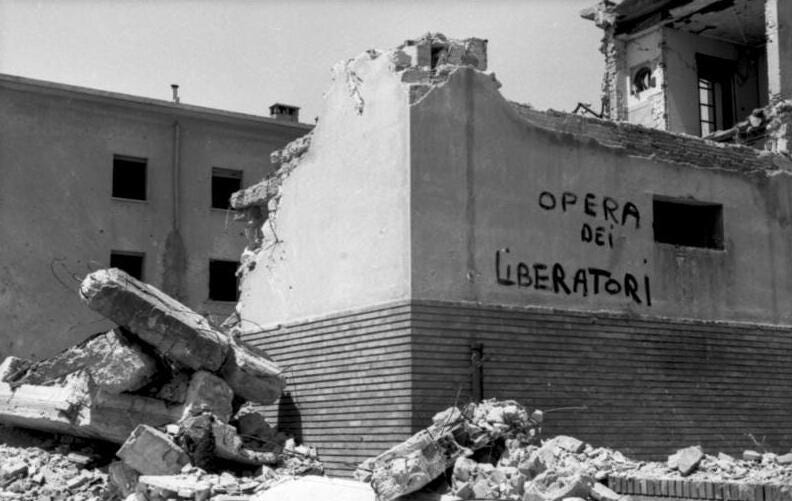
In 1945, Rome was in a state of rubble after WWII had ended. Germany occupied Italy for 2 years, and the fascist period — twenty years of Mussolini — had just collapsed. The city was physically destroyed. The economy was in ruins. Unemployment was catastrophic. And people were genuinely desperate in a way that’s hard to imagine — not inconvenienced, not struggling, existentially precarious. There were no resources and the studios were bombed or broke.
2 directors, Vittorio De Sica and Roberto Rossellini, made films with the resources they had. Their cameras, the streets, and non-actors. Rossellini started the movement with Roma, Open City (1945) using whatever film stock he could find on the black market. It’s not a polished film. It couldn’t be — Rome’s studios were bombed and its entire production infrastructure had collapsed. It featured a cast primarily of non-actors, it featured city streets in rubble, capturing the environment as it existed. He filmed inside the world as it was happening.
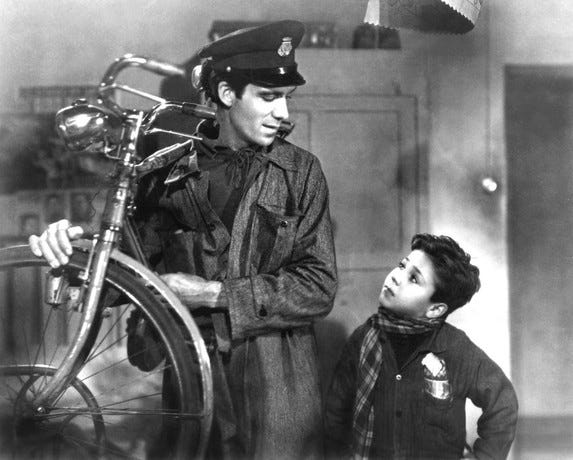
Bicycle Thieves (1948) by Vittorio De Sica featured a cast of all non-actors. A man needed his bike to go to work every day and feed his family. It gets stolen and his whole livelihood is threatened. At the time, this would have been catastrophic. Losing your sole means of transportation meant losing your job. The bike represented the father’s dignity, livelihood, and ability to provide for his son. De Sica was offered Cary Grant (an international star) for the leading role of the father with full financing, but turned it down. Instead choosing Lamberto Maggiorani, a real factory worker who had never acted. Lamberto went on to put on a surprisingly and totally actor-like performance as the Dad desperately looking for the bike. It didn’t look like acting because it wasn’t. He was that man.
Bicycle Thieves is a perfect example of a culturally interior work with authenticity that could not have been faked or researched. Rome in poverty, non-actors, a desperate time. Nothing was imagined with cinematic license. It was all real. And a simple story of a man searching for a bike with his son, shot with simple visual grammar, told you everything about what that time and what those people were going through. De Sica knew this world from living inside it.
French New Wave (late 1950s and 1960s)
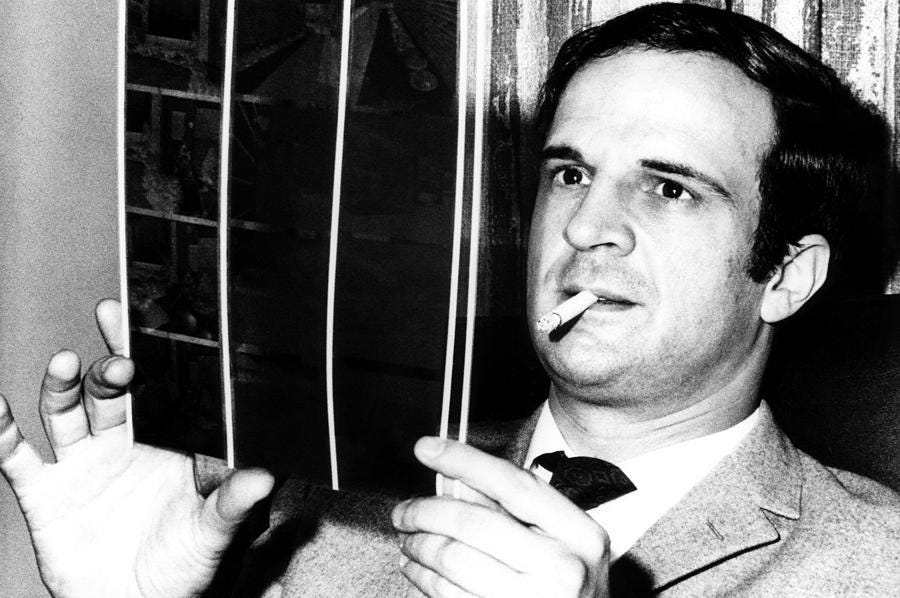
François Truffaut, a film critic, observed that French cinema at the time had an inert, literary quality (he called it a “Tradition of Quality”). It featured prestige adaptations of classic novels by craftsmen who were following rules established by their predecessors. In 1954 he wrote “A Certain Tendency of the French Cinema”, an indictment naming names, attacking the French film industry. He believed that the director’s personality and worldview should be visible in and inseparable from the work itself. And he believed the films that needed to be made, weren’t being made.
His manifesto would seed the French New Wave movement and solidify auteur theory. Truffaut wrote the memo before any of the films existed. The films followed. 4 years later he would make The 400 Blows (1959) after years of obsessive film study at the Cinémathèque Française (the Paris film archive where you could watch films all day every day for almost nothing), while working as a film critic. The 400 Blows was semi-autobiographical — the main character Antoine Doinel was essentially Truffaut as a boy. Neglected by his parents, in trouble with authorities, finding freedom only in cinema and in running. Deeply personal to the point of exposure. It premiered at Cannes 1959. Won Best Director. Truffaut was 27.
3 Takeaways
(1) A Moment of Cultural Intensity: The common thread between neorealism and the New Wave is that they both arose from moments of cultural intensity that necessitated their existence. Both were made by people so inside the world that the camera had no distance from it.
(2) Thesis First vs Films First: Rossellini (who made “Rome, Open City”) just picked up a camera and filmed the world outside. Truffaut wrote a manifesto before the films came. Different approaches, same result.
(3) Interior Truth: Both movements asked the same question: who gets to tell the truth about this world, and what happens when nobody does? They were started by people who refused to accept that the stories that needed to exist weren’t being made. Neither waited for permission or resources. The absence was unacceptable to them. That’s why this fund exists.
What Current Tech Cinema Doesn’t Answer
The Social Network (2010) is the closest example to a deep interrogation of founder psychology we have. But it’s on one person, a 2003 Mark Zuckerberg, made into mythology. What it does well is capture a person before scale, but it’s just 1 portrait.
Here are characters that have yet to be sufficiently explored:
Here are characters that have yet to be sufficiently explored:
early-stage founders
early-stage employees
late-stage founders
late-stage employees
partners to founders / employees
venture capitalists
researchers, scientists
creatives in tech
those unemployed (and the culture supporting exploration)
regular residents of San Francisco (and their relation to people in tech)
the person off tech Twitter with 200 followers that tweets insanely accurate takes from a Victorian in Lower Haight that gets 50 views but is usually right
permutations of the above that doesn’t fit a specific mold (the above are very linear archetypes)
Here are questions that have yet to be sufficiently explored:
what does loneliness in this world look like? what are people here really like? what does it look like to go from a nobody to somebody here?
what does delusional self-belief look like? in its most positive form? in its worst form? what level of faith and foresight does it take to build something new? what are the consequences taken to its extreme end?
what does love look like? romantic relationships between founders, employees, or others not in tech? what are the tensions? desires unable to be met?
what does greed look like? optimizing for TC at the expense of everything else? where does that work? where does it fail? what does the striving look like?
what does the social scene look like? how do tech people interact with the physical city they are in? what does tech twitter as the primary communication model look like?
how do people talk? what does being terminally online really look like? what does functional autism look like? how do people walk and carry themselves? what do they avoid doing? what are they drawn to?
what does overoptimization look like? neuroticism beyond reason? a singular focus that is confusing and unreasonable to onlookers.
what does sacrifice look like? not abstractly. in a body. in a marriage. in friendship. what does growing through that look like?
what does it feel like to build something that becomes something you didn’t intend? to watch the thing you made with genuine idealism cause harm at scale? and deciding who you are in relation to that.
what does a high-growth startup look like? what are the ramifications on psychology?
what does leaving the industry feel like? the engineer who walks away from salary, mission, identity, and has to reconstruct themselves outside the only world that ever made complete sense.
who are these people really? not the myth. not the caricature. the actual human beings underneath.
None of this exists cinematically. That’s what we exist to fund.
What We’re Looking For
A script for a short film, 15-20 minutes long.
The criterion is not a résumé. Not a zip code. Not a job title. It is interiority. A relationship to this world that got into you before you knew it would matter.
You don’t need to have been a founder or an engineer. You just need to know this world from the inside — its specific people, values, contradictions, and way of being. The script will know if you do. The details that are too specific to have been invented. The silences that assume shared knowledge. The things that are in the script because they had to be — not because they were written but because they were lived.
You might be a director already producing commercial work for startups. Or a freelance videographer in San Francisco. You might be a founder who moved away. An engineer who writes screenplays and studies film as a hobby. A producer from LA who moved here and is figuring out the cultural landscape you now work in. There is no exact shape to who the recipient of this grant could be.
We’re uninterested in funding outsider interpretations. Dramatic work written from guesses or “wouldn’t that one line be funny.” Hacker thrillers. Cautionary tales on social media. If you have to make anything up, related to the core characters and story, without it being grounded in true life experience and observation, we are uninterested. Please do not submit your script.
Good scripts will/may have:
details that are too specific to have been invented
scenes included because they really happened, rather than just being dramatically effective
characters only people in tech would recognize immediately
locations that are too specific to the world that they had to have come from lived memory
some core unresolved question the filmmaker wants to answer
interior stakes that are too specific to have been invented
dialog rhythm that is too specific to have been invented, it had to have been heard
basically, a lot of things that are too specific to have been invented
If you have a script like this, we want to read it.
The Fund
Creative talent with the interiority to tell these stories exists, but no capital structure, void of private interest, has formed around them to take their craft and the stories they hold in their heads seriously. To take storytelling as a career seriously.
This fund is that missing structure. To greenlight stories that need to get made right now. To create structure around what is right now a nascent commercial filmmaking scene.
We are not a startup with a product we need to market. We are not a venture capital firm. We have no portfolio. We have no favorites. Having a product is fine. Having a portfolio is fine. But because all of these interests rarely align in the best interest of broader culture, a neutral institution needs to exist.
We simply look at gaps in the technology industry’s storytelling, and aim to fill them with truth. That’s it.
The Grant
$15,000. Awarded to 1 filmmaker to make 1 short film.
on budget
You don’t need a big budget when you have something true to say, and the craft to say it well. Medicine for Melancholy (2008) was made by Barry Jenkins on $15k (~23k today). 2 characters, handheld, San Francisco as backdrop. Through the rawness of the performances, you could still sense something very true being said, and you could clearly sense an early & powerful directorial voice in his shot grammar. Constraint can create great things.
Submission
You know if this is you. You’ve known since the first paragraph. You have a story that couldn’t have been written by anyone else. We’re building this fund for you.
Send your script to scripts@svfilm.fund. I will review every script submitted.
on submitting
Include (1) your script as a PDF, (2) a short note on who you are and why you’re the one to tell this story — one paragraph, no formal cover letter needed — and (3) any previous work if it exists. Previous work is optional. The script and the note are not.
Submissions close June 10. I will read every script. I can’t reply to every submission, but if your script is the one, you’ll hear from me. All submissions are subject to a standard submission release agreement, which you’ll complete before I read your script.
Love this initiative and excited to submit to this as well :)
"Not taking agency over its authorship would be a mistake." YES. Excited to submit to this.