
tl;dr: The first cycle of the Silicon Valley Film Fund, running from March 10th to June 10th, recently closed. 13 scripts total were submitted. I cover the 14 things I look for in a script: strong character identity, protagonist identification, spatial awareness, sonic resolution, emotional awareness, dialog rhythm, control of pace, tonal control, formatting, premise & originality, axes of conflict, and opening & ending. Weaving in exemplary films and a sample from the hit movie Obsession.
I recently closed the first round of SVFF (the “Silicon Valley Film Fund”) which ran from March 10th to June 10th accepting scripts for short fiction films based on the technology industry. Over 3 months, scripts@svfilm.fund received 21 emails, 17 releases were sent, and 13 releases were returned. So 13 scripts are sitting on my dining room table waiting to be read after I post this.
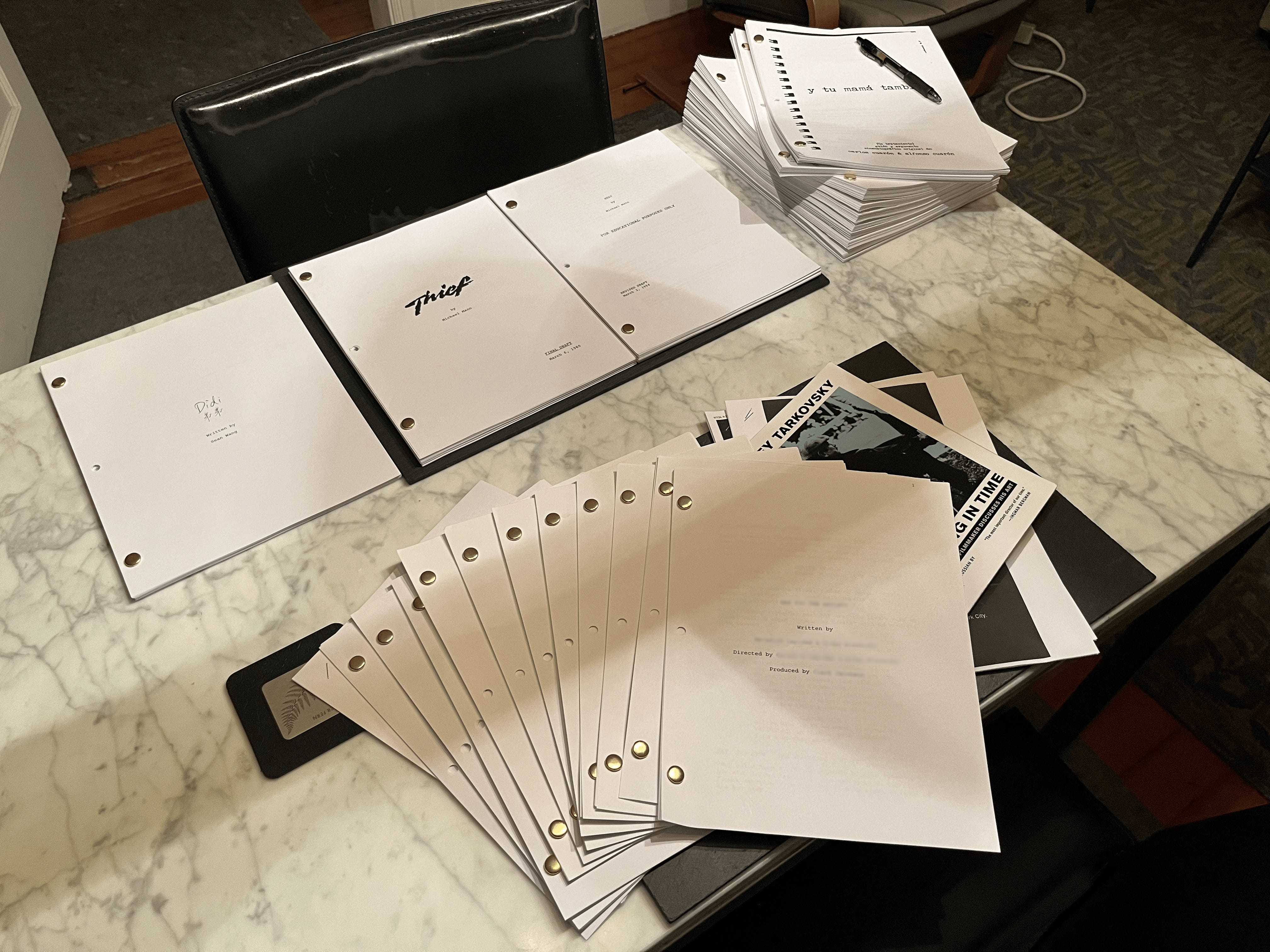
I started the fund with a question: “if you remove the financial barrier to making a minimum viable film based in tech, what would happen? who would surface? who is writing stories and imagining this world anew?” I quickly found out the answer is almost no one. In the first 2 months of the fund being open, after 50,000 impressions on the announcement tweet, I received 3 emails, and only 1 was a tech-adjacent script. This sort of made me panic, was no one trying to create serious film work on the most consequential industry on Earth?
Afraid of the first cycle closing with no scripts, I began writing myself. For a while I’ve been seeing a specific character and specific scenes where they are saying and doing funny things and at some point while pacing around my place I decided to get Highland Pro (screenwriting software) and write them down.
At this point, I had only read 6 feature film scripts (Anora, Pulp Fiction, Boogie Nights, Sinners, Fruitvale Station, Moonlight), so I got the general gist, but that’s very different from having screenwriting grammar internalized and knowing how to write.
I spent 5 weeks through the end of March and all of April writing the first draft. Writing 2-4 hours every morning.


Before this, I’d only written a few (6) small 1-minute commercial scripts in January for a marketing campaign for @arlanr. So I just had to learn things as I went, reading a few more scripts (The Social Network, Punch-Drunk Love, Whiplash, The Breakfast Club, Cigarettes & Coffee 1993, Her) and watching a lot of YouTube videos on writing.
At no point was I sure that the writing was going anywhere, nor did I understand the full story/through-line until the last few pages. I was just following scenes that started as stems, extended them, and eventually they began to connect.
There’s a Stephen King quote from “On Writing” that I kept regurgitating to anyone during this time:
… during the course of an interview for The New Yorker, I told the interviewer (Mark Singer) that I believed stories are found things, like fossils in the ground, he said that he didn’t believe me. I replied that that was fine, as long as he believed that I believe it. And I do. Stories aren’t souvenir teeshirts or GameBoys. Stories are relics, part of an undiscovered pre-existing world. The writer’s job is to use the tools in his or her toolbox to get as much of each one out of the ground intact as possible. Sometimes the fossil you uncover is small; a seashell. Sometimes it’s enormous, a Tyrannosaurus Rex with all those gigantic ribs and grinning teeth. Either way, short story or thousand-page whopper of a novel, the techniques of excavation remain basically the same. — Stephen King, On Writing: A Memoir of the Craft (pg. 163-164)
Creative writing requires a non-linear mode of thinking that I’m entirely not used to coming from engineering. You carry half-formed character identities, motivations, locations, scenarios, for long enough a span of time until something appears. The best writing comes from long spans of doing what would outwardly look like nothing (going for a walk, a bike ride, staring at a wall) and coming back to the script with the problem solved and 3 more leads on where to go next. The process is entirely invisible and almost the exact opposite of engineering work, where output can be approached linearly & scheduled — fast, verifiable, visible, shareable.
Reading Obsession
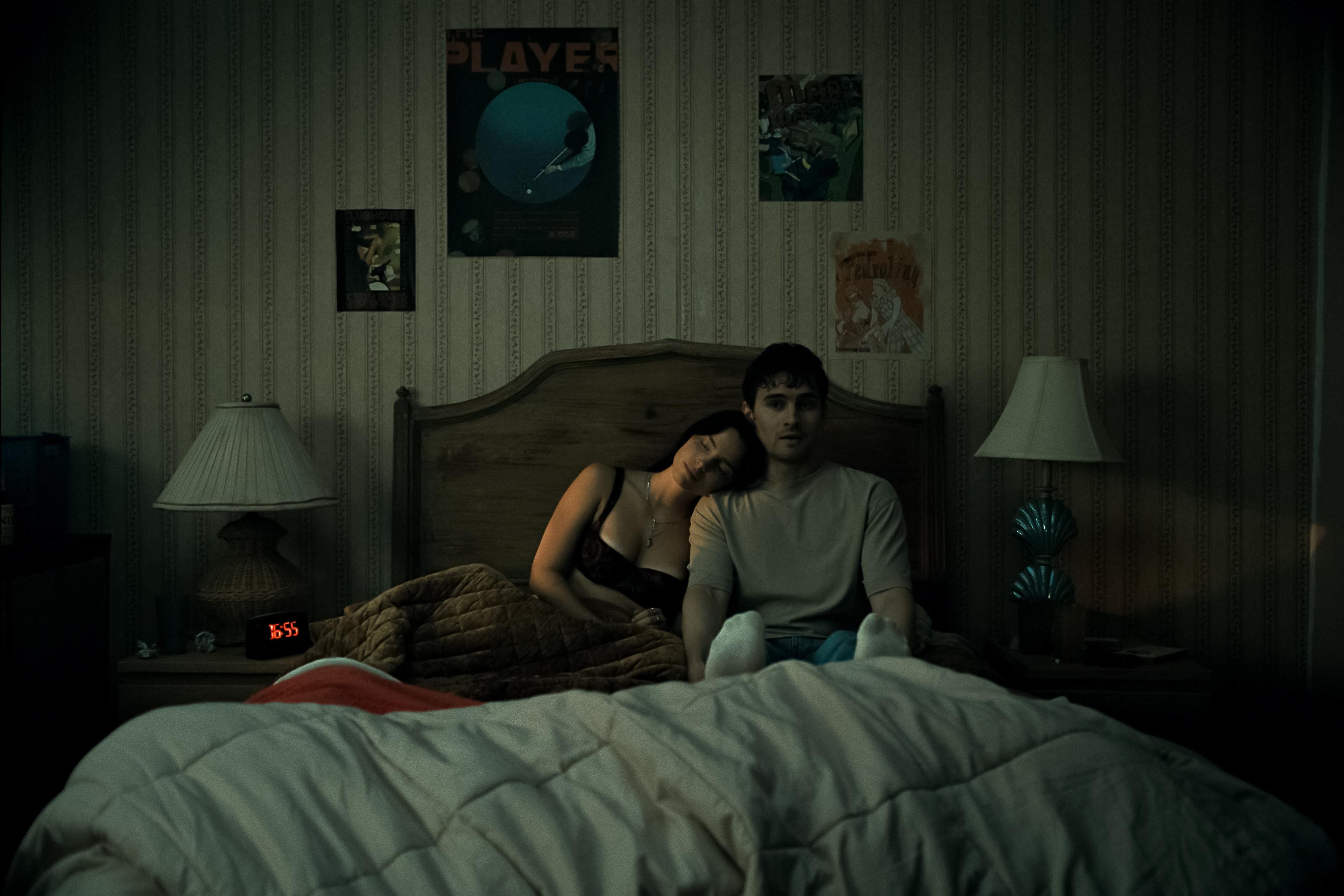
Near the end of May (the 20th) I watched the movie Obsession (released May 15th). I didn’t think much of it and honestly walked out thinking the characters & story were thin and the writing very barebones. But Inde Navarrette’s performance shook me. There was a point while watching it, about 1 hour in, where I couldn’t really locate myself or my sense of place because her behaviour was so strange, so beyond what you’d encounter in a normal human being, that I had to do a double-take and really pay attention to get a fix on who this person was. I knew there was something special about that performance specifically.
The film is now on track to become one of the top #20 highest-grossing horror films of all time, standing at $286M after it’s 5th weekend (source: The Numbers).
Around this time, I had just finished reading the script for Her (2013), so I went looking for this next. I was curious how much of Indie’s performance was found on-set versus known on the page (and the answer is a bit of both). I found the script here. (many people are surprised to find out that the scripts for their favorite movies can be found for free online, and…yeah they are just online and you can print them)
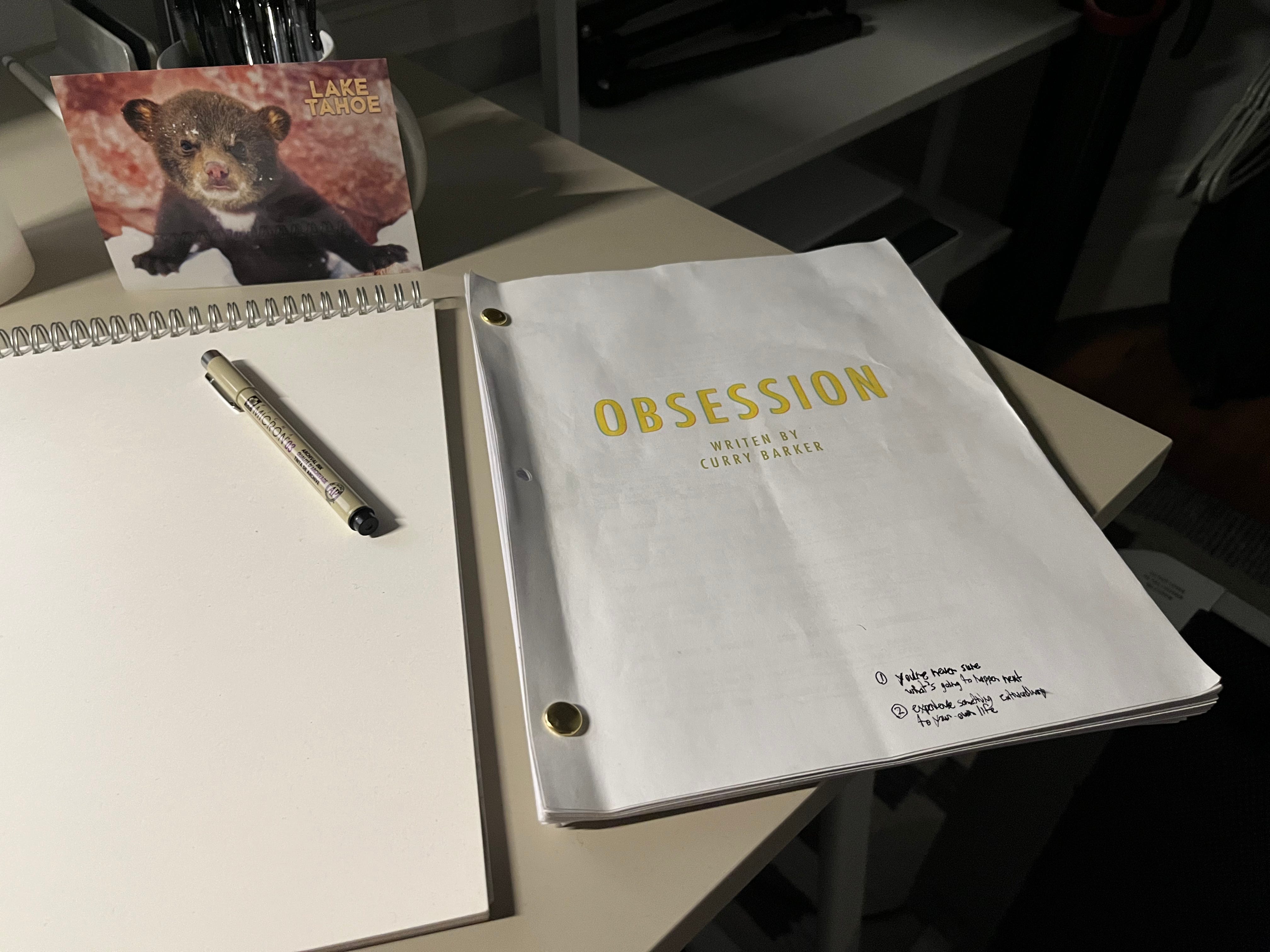
Given the first cycle of SVFF has closed and I have scripts to read, I thought that this would be a good time to talk about what I look for in writing, using Obsession and other scripts from great writer-directors as examples.
What Makes a Great Script
As a disclaimer, I’m not a professional script reader or writer, but I do think I have a strong sense for a good story that moves me when I see it. From the 10 feature film scripts I’ve read so far, a short film first draft I’ve written, and 500hrs+ of cinema watched in the past year, I can pin what I look for down to 14 things:
Strong Character Identity: The writer has fully realized the characters as full people in their heads and maintain that distinct identity throughout the script.
Character Backstory: The writer understands their characters’ full history, what went wrong, what went well, deep desires for the future, deep regrets of the past — the history that makes them, them.
Mannerisms: Whether it be a nervous tick, a specific way their eyes move between people, cutting people off mid-speech, or walking a certain way.
Physical Traits: Are they tall? What ethnicity are they? What does their face look like? How does the way they look make people feel?
Protagonist Identification: When watching visual media, you will identify yourself with 1 or more characters as the film runs. This identification process can be deepened by the central protagonist doing relatable things: falling in love, getting abused, wanting to be accepted, fearing something. This anchors the watcher to the story because they see themselves in it somewhere. Stories that fail to complete this process early will struggle to hold viewers throughout the film. Stories that complete this process can do almost anything with watchers, make them feel jolts of pain, euphoric highs of finding love, etc. (and of course it’s not a hard rule to have a single protagonist…there really aren’t any hard rules…ever)
Vivid Spatial Awareness: The best writers have a vivid sense of space. Where are characters positioned? How far are they apart? Which way is their body pointed? How wide and tall is the room? How large are objects? How fast is the car moving? What is the map of the city/neighborhood/courtyard? All of these will be resolved as if they were seen (but this does not mean that the words on the page are any more complicated).
Sonic Resolution: Can the writer hear the setting where a scene takes place? What ambient sounds are heard? Does the room echo? What’s their character and texture? Do they know when music cues and fades out? This is more optional. Moonlight (2016) is an example of an action-driven, sonically precise script, w/ Barry Jenkins being a more poetic writer.
Vivid Emotional Awareness: Throughout the story, who wants what? Who is on their back heels? Who is powerful? Who is hurt? Who is carefree? Who has a specific edge over who? Under what conditions would character X do what character Y wants? Under what conditions would character Y not do what character Z wants? The writer has a sense for every character’s inner world at all times.
Dialog Rhythm: Does the dialog sound like the writer is trying to write, or does it sound like a conversation overheard? Real speech is messy and not step-by-step. Every exchange of words carries rich subtext that stretches far beyond what’s heard (hidden desires, power changing hands, backstory). The best dialog sounds like music, information speeds up and slows down, moving in waves. Bad dialog reads jagged and mechanical, with an odd meter to it. There are whole books just on writing dialog.
Control of Pace: The writer has a strong sense for the “speed” of the story at any point in time, and can speed up or slow it down at will. Pacing interior to scenes and across the script are controlled. Stakes escalate cleanly across the entire story. The revealing of information speeds up and slows down instead of staying uniform.
Tonal Control: One of the most difficult things to write and even more difficult to direct across a whole film. Does the writer have granular control over the tone watchers experience line-by-line? Scene-by-scene? Act-by-act? This is knowing the “taste on watcher’s tongues” at any point in the film during writing, directing, and editing. Parasite (2019) has strong tonal control; Obsession has it too. Takes a decade+ to internalize at the highest level.
Formatting: Similar to “Control of Pace” but specific to how pages are formatted. Are sections sparse (reading speeds up)? Dense (reading slows down)? This changes how the picture unfolds in readers’ minds (actors, crew, collaborators, etc) and ultimately changes what ends up on screen. Every character has a story effect, down to the em dash “—” used in dialog or leaving out a period mark “.” at the end of sentences. This doesn’t mean perfectly typed sentences; it means carefully considering the effect of each character. The perfect formatting could lead to an “ugly” page that reads and paints the picture perfectly. Whiplash (2014) is basically a perfect script in formatting.
Premise & Originality: Does the film create a new world that hasn’t been seen? What else does it look like? Is there direct imitation instead of original thinking (copied vs. synthesized w/ coherent logic)? Is this giving watchers something new? Something they need?
Axes of Conflict: Conflict is what forces characters to make decisions under pressure, driving the story forward to a meaningful conclusion. How many “lines” of conflict can you draw between characters? Does it look like a complex web or a single straight line (one-dimensional)? Is the conflict profound and story-motivated? Or is it contrived? The best stories have several layers of rich and meaningful conflict. Flat stories have 1 axis of conflict that anyone could think of.
Strong Opening & Ending: Does the ending land? Did every scene build to it and stay consistent to the through-line? Is the opening strong (relates to “Protagonist Identification”), visceral and cinematic (not necessarily violent or dramatic)?
Commercial Viability: Can this actually be filmed? By this specific producer-director with this budget? A period drama in the 1800s is going to be very difficult to make because the whole world has to be built: costume, production design, hair & makeup.
Heart: And most of all, does the writer have a personal stake in this story? Did they suffer in a particular way to give them this perspective? This is not to be hand-wavey; it concretely translates to whether a room full of hundreds of strangers, or a fast-scrolling timeline, with no one telling them what to think and feel, end up being moved and changed by the story. You can’t access people’s deepest, darkest memories unless you reach yours first and move them to the page. It seeps into every line of action and dialog, changes how you motivate collaborators and crew, and ultimately, who decides to finance the project. Great stories leave an emotional residue that remains long after the story has been consumed (good films that do this Hamnet 2025, Past Lives 2023, Y Tu Mamá También 2001, A Man Escaped 1956, Come and See 1985).
This is a long list, but most of it boils down to: did the writer see what they were writing, instead of writing to extend the page. What the writer could not see is left open-ended.
The Absolute Basics
It’s easy to forget how strange film is as a medium. You might think you’re watching real people going through real locations deciding what they are saying in real-time, as if you were there. But when you remember that it’s entirely a constructed illusion that feels real you begin to see the seams and get curious. If the image projected in front of me isn’t the actual thing, how am I constructing the world that feels so real? Who are these characters to me specifically? Why does cutting between shots work and not disrupt me? The illusion unravels.
This would completely sidetrack this article (and whole books have been written on what cinema is), but what’s really going on is you are bringing yourself to the film as you grapple to understand it. Characters merge with associations of people you know. Locations merge with childhood memories. Actions that don’t make sense are creatively interpreted. Every film plays as a unique experience in the hundreds of minds in the cinema, in unison on story texture, but experiencing completely different inner worlds. We will SIDESTEP this complexity to say…
A screenplay is a blueprint for describing how this new world flows in time. In the most economical way possible, it describes what viewers will see and what they will hear. The answer to “when” they will see and hear specific things is metered in the writing itself (or through action).
A script is made up of 3 building blocks:
Location: Where we are as watchers. (written in the “scene heading”)
Action: Events that happen on or offscreen.
Dialog: What characters say.
That’s it. These 3 building blocks allow you to describe the visual world that you are seeing/want to realize and transfer it to readers. There are no hard rules other than achieving that goal. Anything else about formatting can be searched, and learning proper story texture just comes from reading a lot of scripts and watching a lot of film.
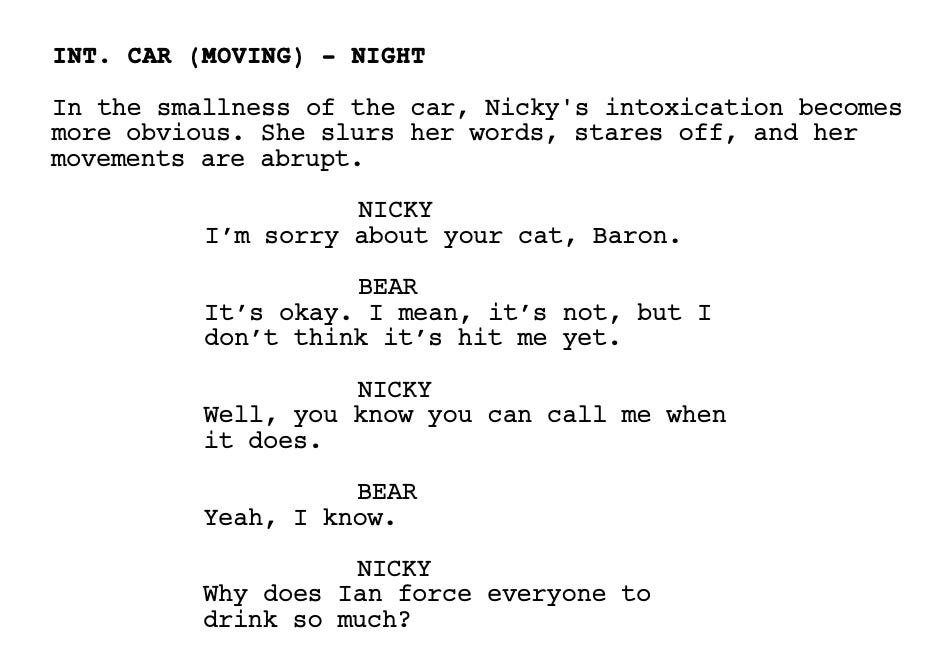
In the above, we have 2 characters in a moving car at night. Nicky and Bear. Nicky is intoxicated. We are on notice to expect it to worsen as dialog proceeds. By the end of reading this snippet, you are in the car, seeing any one of the following:
Facing Nicky (who is sitting in the passenger seat) from behind Bear’s right shoulder. (camera behind his seat)
Facing Nicky from outside Bear’s window, in a 2-shot with both in-frame
Outside the windshield facing in, in a 2-shot with both in-frame
Close to Nicky’s face, then switch focus to Bear right before he speaks his first line
But those details are omitted from the page. Some writer-directors “hardcode” camera position & movement, like Paul Thomas Anderson, but most stick to the story (the essentials of what happens to whom and where).
An analogy I like to think of is that screenplay form is like an empty glass cup. It provides the rigid structure for holding liquids (audio-visual experience suspended in time), but torturing and studying glass shape and properties (subtext, compression, pace) doesn’t bring you much closer to putting juice inside it (having something unique to say, something specific and necessary to look at). This is ultimately the hard and rare thing.

Back to the Points
We’ll speed-run through each point in no particular order, moving between Obsession and other exemplary scripts to illustrate.
Scripts you’ll want handy: Obsession (2026), Fruitvale Station (2013), The Breakfast Club (1985), Moonlight (2016), Thief (1980), Rosetta (1999)
Vivid Spatial Awareness
Screenplay prose is dead simple. So simple a grade-schooler can read it (typically lands around grade 6-8 in reading level). It’s simple sentences chained together to paint a picture. Unlike a novel, which is the final artifact, a script only exists to communicate a film to the people who will make it.
Despite reading simply, there is a mountain of visual and temporal complexity that has been worked out sitting behind these simple phrases. And it’s often indistinguishable at first glance whether a writer has inhabited the world they are writing about with high resolution or whether they have written characters just to extend the page.
Fruitvale Station (2013) — Subway Car
A scene I find myself returning to to illustrate this is this scene from Fruitvale Station (2013), written by Ryan Coogler (script here). Coogler is a writer who writes simply but sees space with extraordinary detail. In the following scene, he tracks the position of 14 characters in a BART subway car as they cross to San Francisco for New Years:
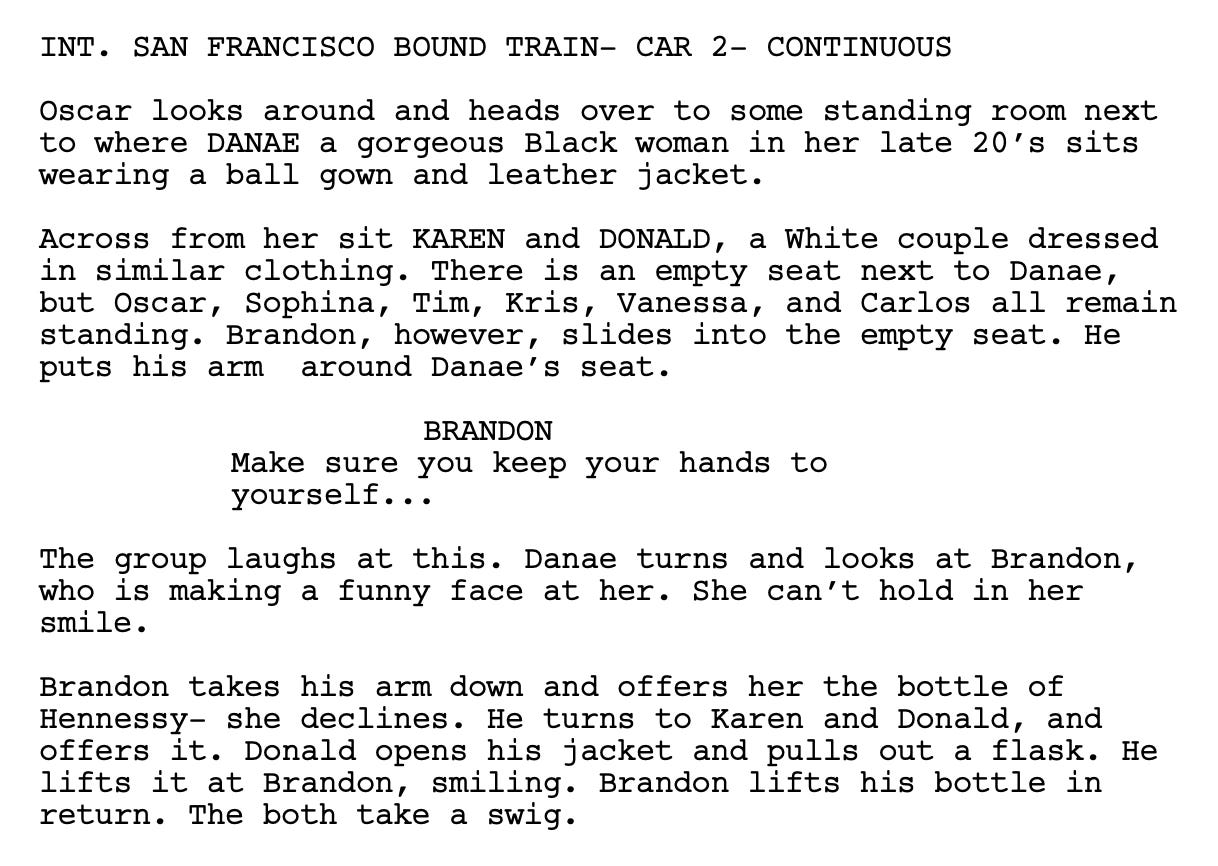
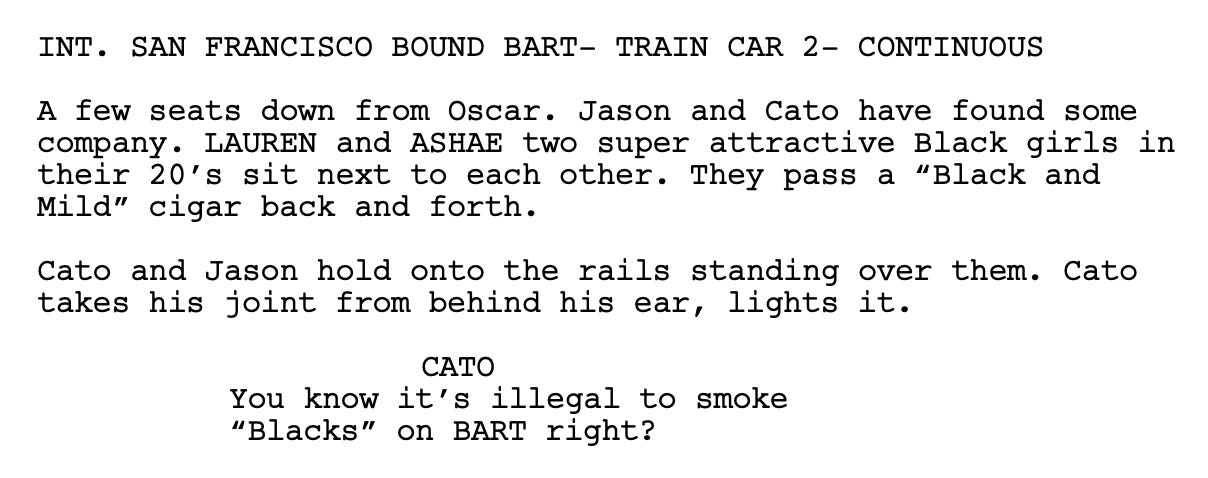
After reading, you may see a layout roughly like this:
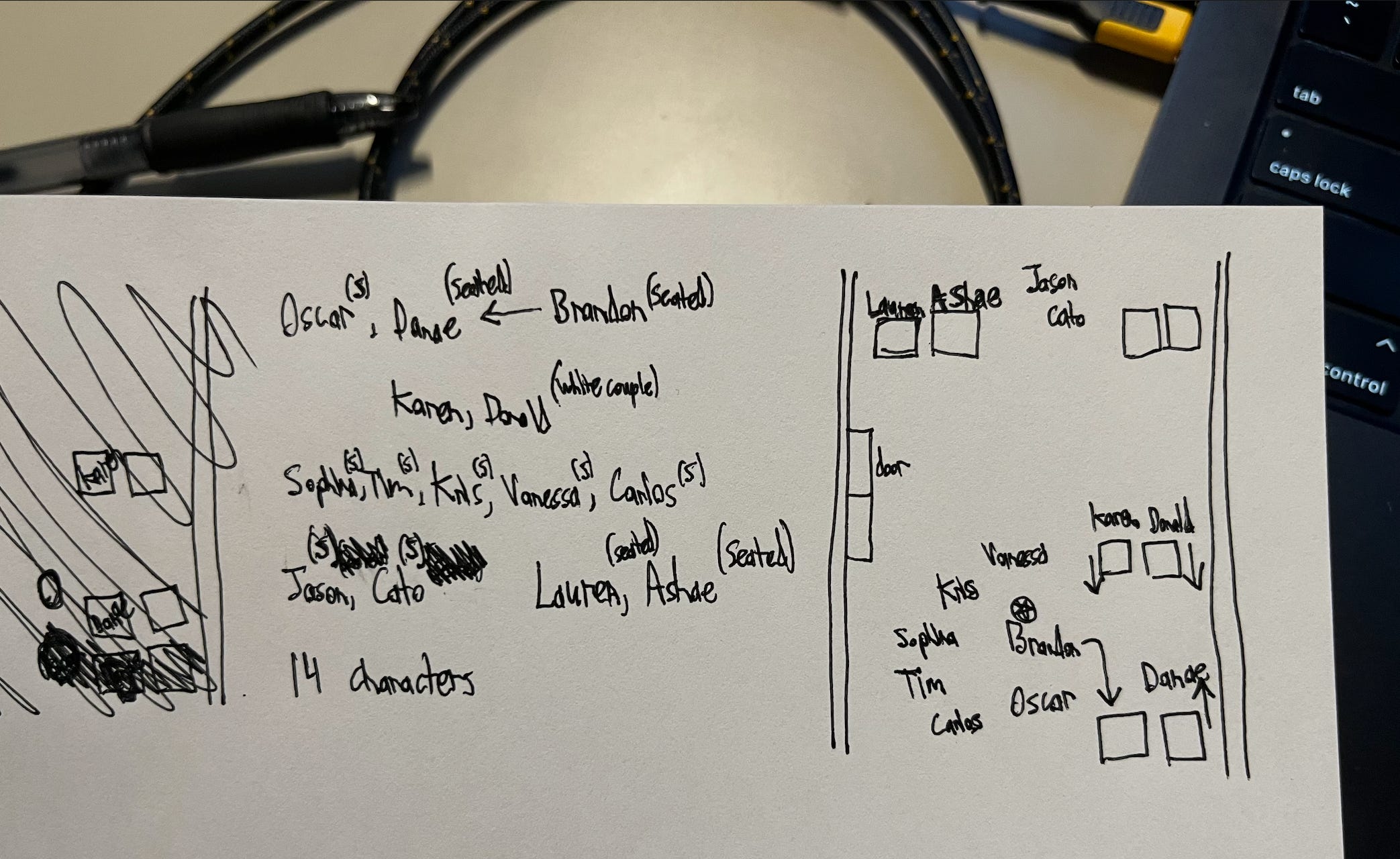
And the passage materializes in the film like this:
What follows is dialog that rests on this spatial foundation. Characters passing items to one another, looking in various characters’ directions, laughing and facial expressions in reaction. None possible without a clear idea of who is where.
Coogler would go on to win an Academy Award for Best Original Screenplay for Sinners 14 years later (which I also recommend reading).
The Breakfast Club (1985) — The Library
Another great example is this snippet from The Breakfast Club (1985), it’s a very economical film, using a cast of 5 students caught in high school detention held in the school library (1 location). Despite being lean, the film’s power comes from cast design and performances.
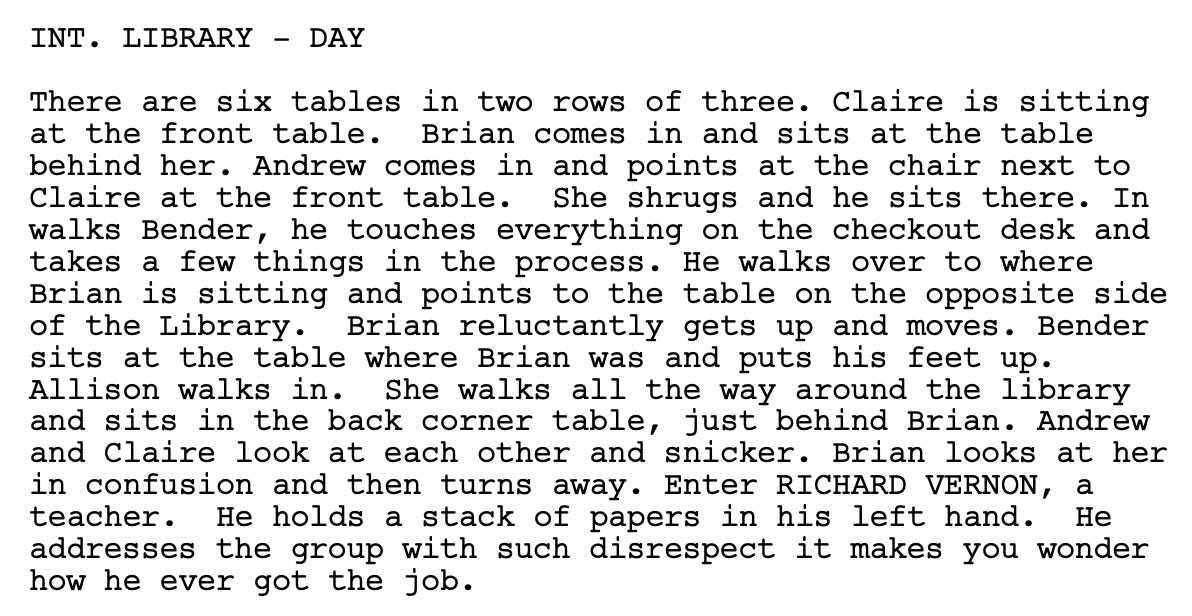
After reading, you may see a layout roughly like this:
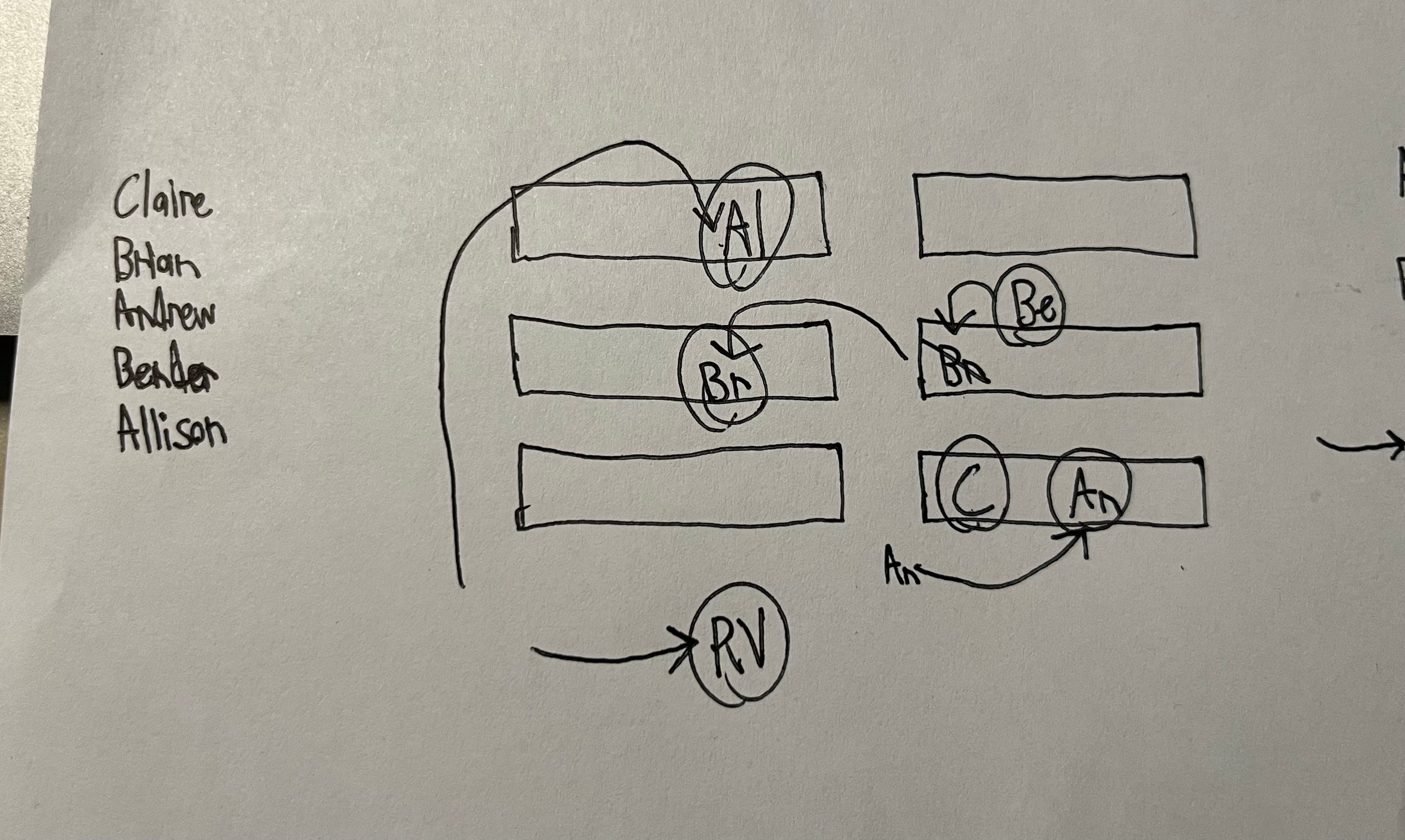
And the passage materializes in the film like this:
Tonal Control
One of the main tasks of the writer at writing time, and the director on set, is to understand the tonal texture of what they are writing/capturing at any given moment, both local to a scene and global to the story as a whole. This invisible emotional texture is like a quilted fabric that runs across the entire script, changing scene by scene, act by act, line by line.

Strong writers/directors see the whole quilt (or very large regions of it near to where they are) and can project the effect of their words, or an actor’s performance, on the viewer's emotional state at any given point in time. What are they anticipating? Where are they confused? How long can they stay confused? What do they fear? Where should things speed up? Slow down?
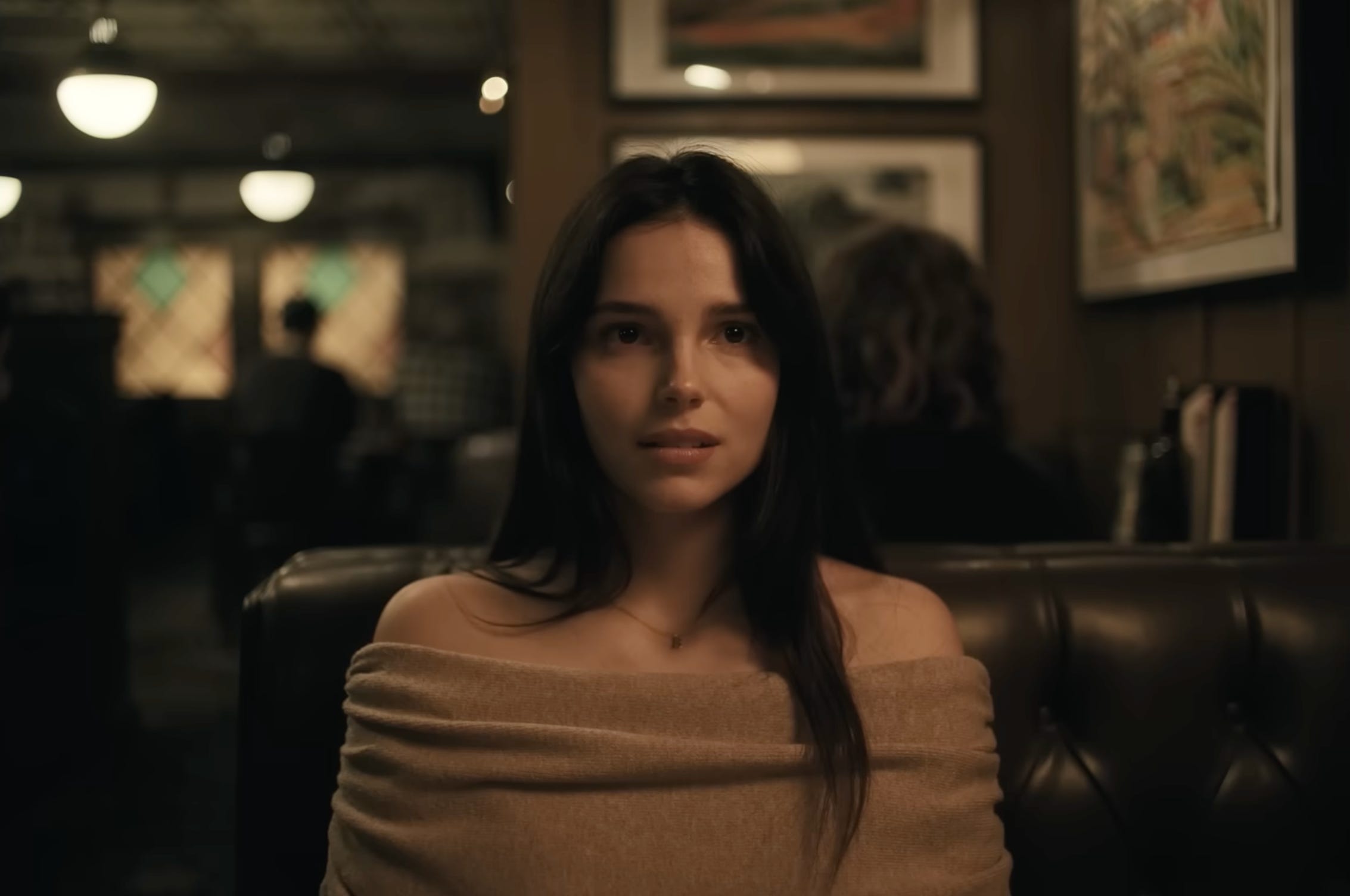
Obsession is a quilt that depends almost entirely on 1 actor’s performance, Nicky (played by Inde Navarrette) escalating in intensity across acts and varying more and more wildly within scenes themselves. The most signature scene in the film happens when Bear confronts her about her Dad allegedly having cancer; it turns out she had lied about it.
After reading the script, it became clear that most of Nicky’s performance, in concept, was on the page, and only magnified with Inde’s interpretation & Barker’s control in direction.
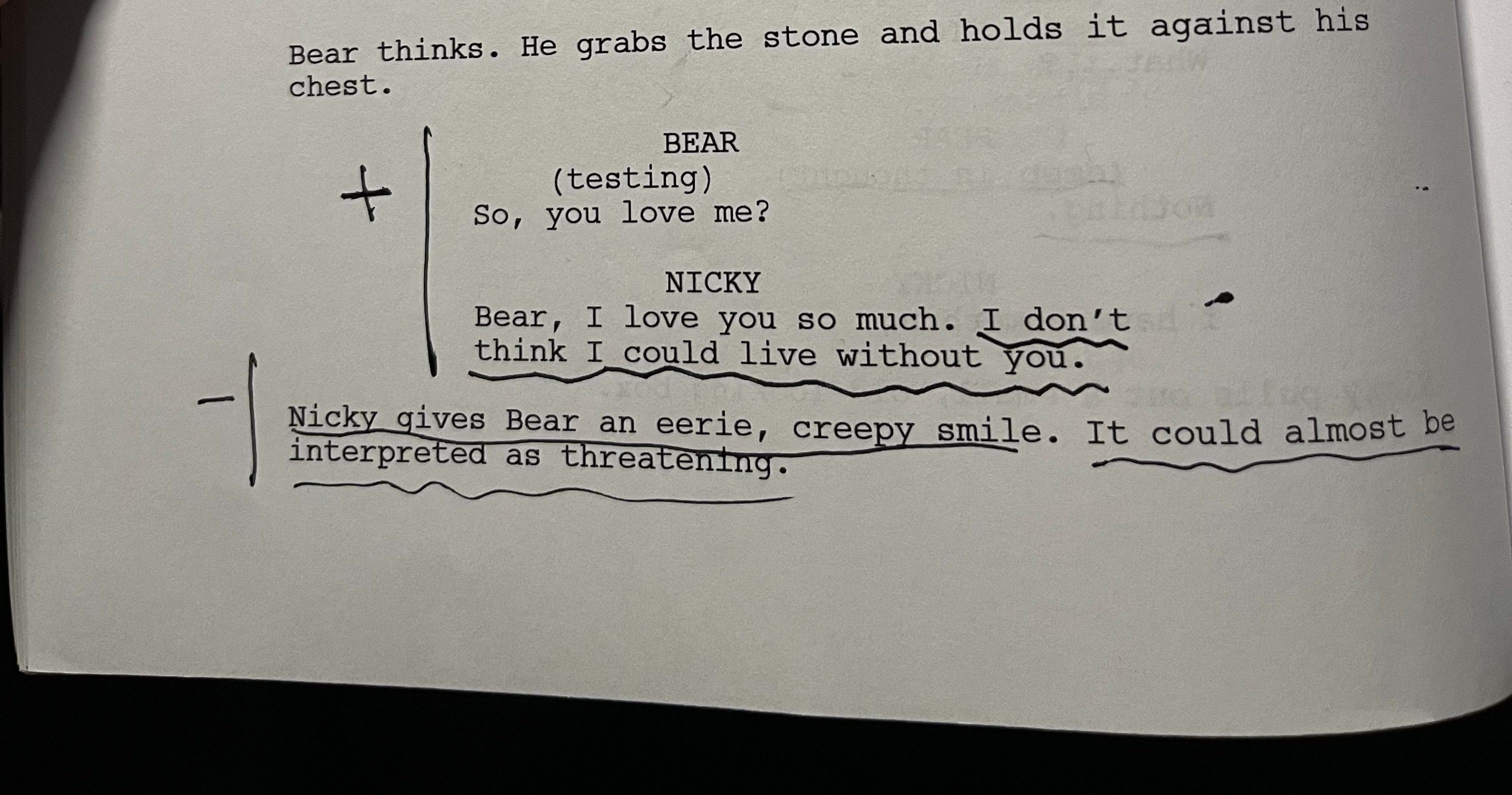
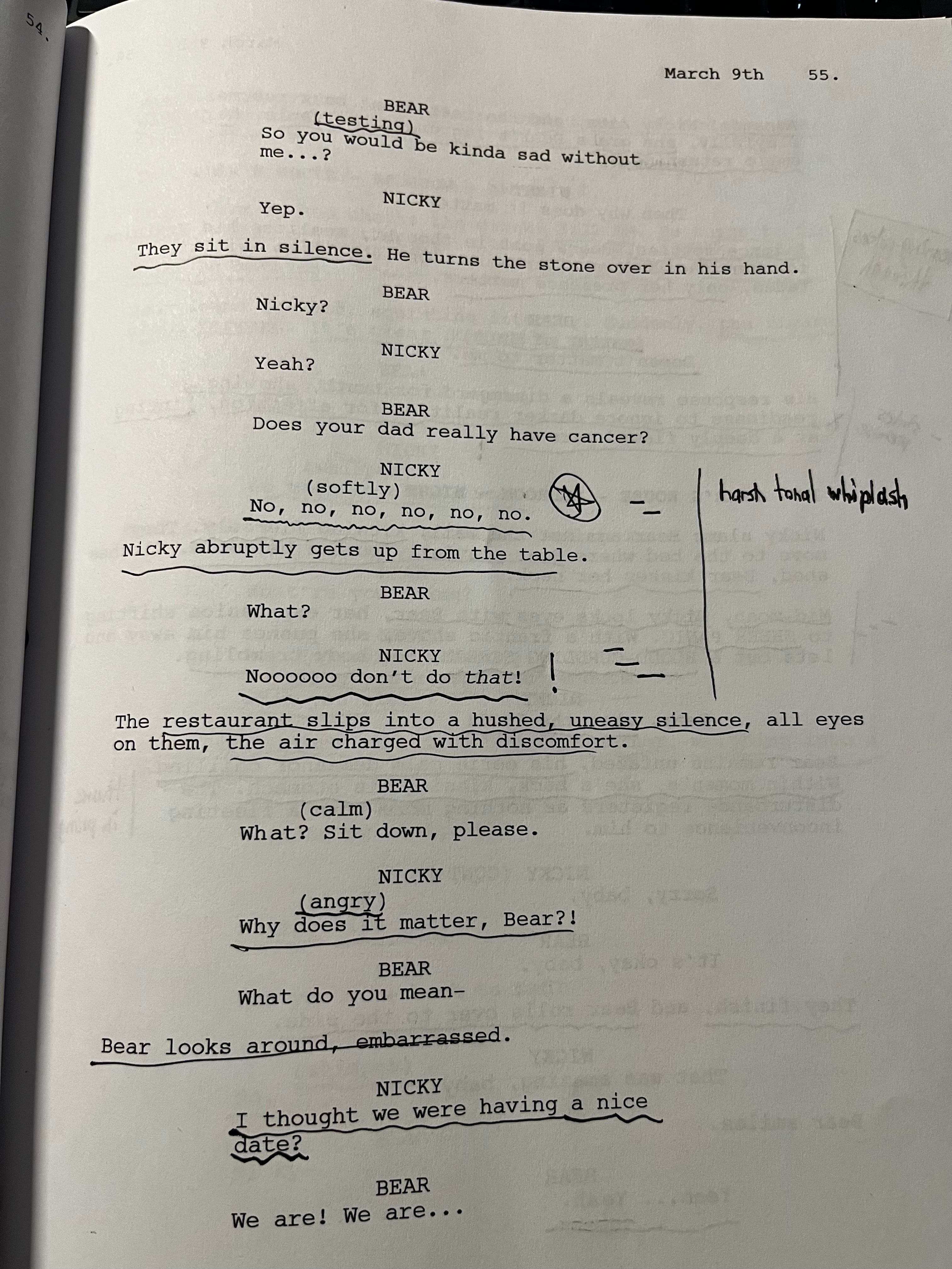
The film is essentially this same tonal whiplash tightened and tightened until it becomes unbearable to watch by the end. Strong tonal control in writing and a great achievement in direction. Essentially a chamber piece study in controlling tone, at least on one dimension (fear), in the horror register.
Sonic Resolution
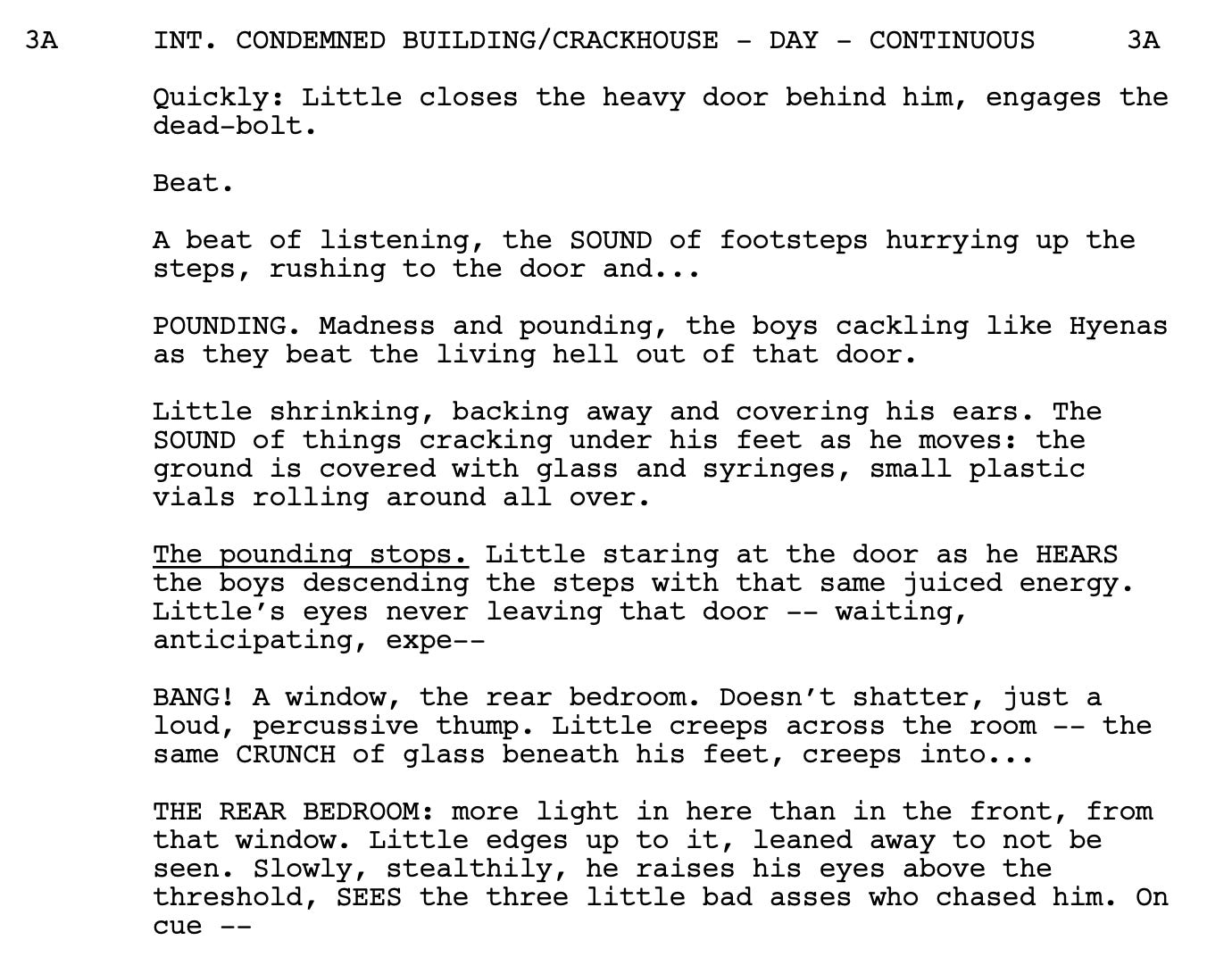
When sonic details become significant enough to the story, you will see writers write them in. A good example is Barry Jenkins in Moonlight (2016). In the following passage, the main protagonist “Little” is being chased by a group of neighborhood boys where he takes shelter in a crackhouse for cover:
And the passage materializes in the film like this:
This ties into Protagonist Identification (which we won’t individually look at), but you can see how by page 3, we are bonding with the character and identifying with their abuse, wanting them to be rescued. We become them for the rest of the runtime.
Sonic detail in this high a resolution in writing is not mandatory since readers can usually fill in the gaps, but for this scene specifically, it was exactly what was intended to be shot, so it had to be written with such precision.
Dialog Rhythm
Film is similar to music in that both are time-based mediums, susceptible to the rhythms and properties of story information being interpreted moment by moment over a fixed span of time. Once image and sound are captured and played back, their consumption takes on a natural cadence (in effect regardless of whether you notice it).
A script can be thought of as a score for life.
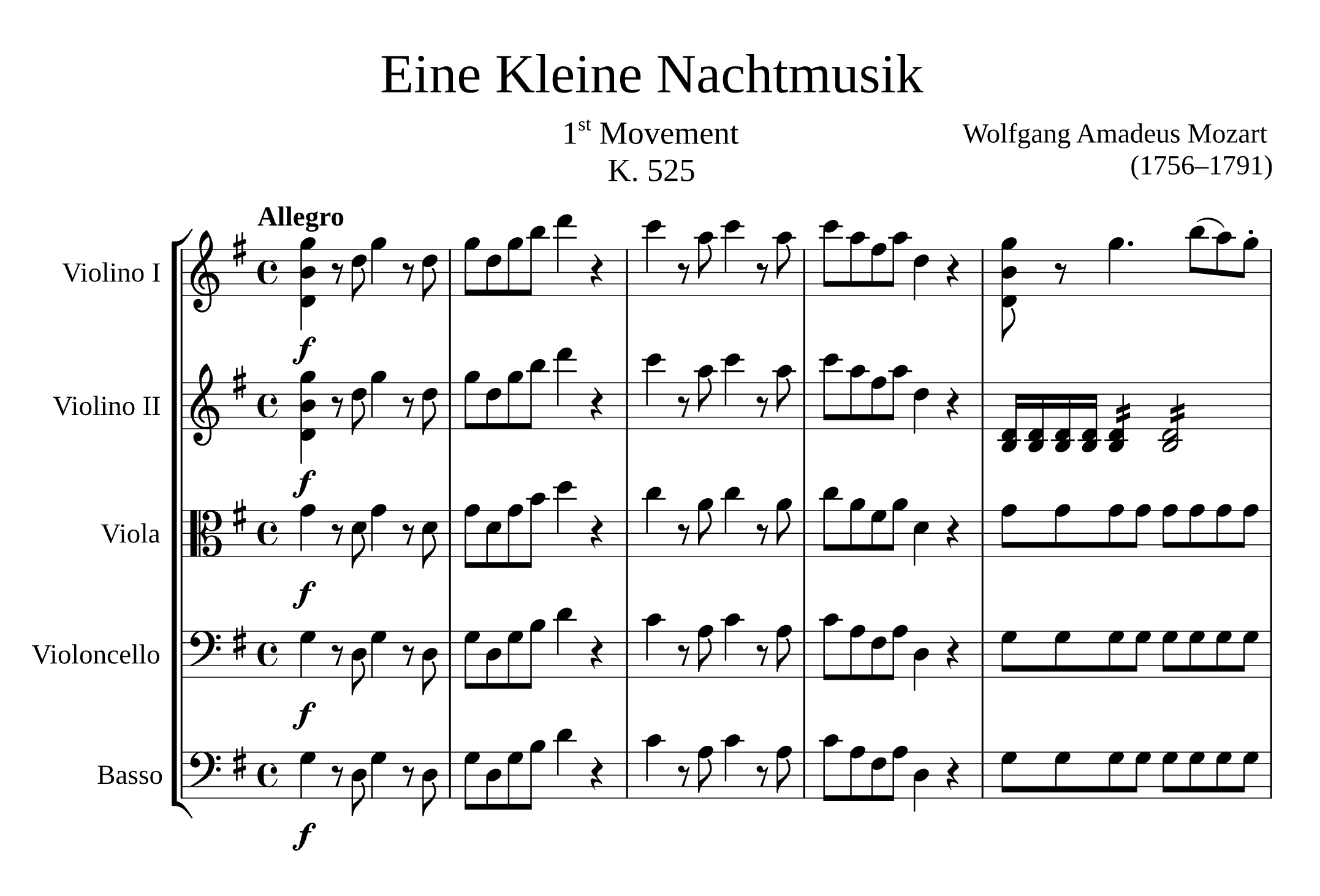
Dialog is a compressed form of speech. Regular everyday speech is too inefficient to translate directly to a film/script, since every block, every sentence, of dialog is ideally doing 2-3 things:
revealing character (how someone talks reveals who they are)
advancing plot (information exchanged, decisions made)
establishing relationship (power dynamics, history, intimacy)
creating subtext (what’s not said, what’s said wrong)
setting tone (the emotional register of the world)
building or releasing tension
delivering theme (indirectly)
Speech Rhythm In Everyday Life
In an interview, director Ryan Coogler said that he likes to listen to the way people talk in public or when riding on the bus, so that those natural cadences help inform his writing.
I’ve begun to do the same, and I now naturally find myself in public listening closely to the cadence of how people speak, observing how light falls on their face, what is revealed about relationships when the speech stops (body language, distance, facial expression). A lot of story information moves non-verbally.
The work of Robert Bresson (simplified performances) & John Cassavetes, particularly Faces 1968 (as a canonical example on communication through pure facial expression in close-up), have been very influential on this practice of observation. I think watching so much film just trains you for this mode of attention in day-to-day life.
Thief (1981) — Car Ride
There are more overtly lyrical writers like Quentin Tarantino that push their dialog towards a musical rhythm (the “foot massage” dialog from Pulp Fiction for example). But a director I particularly like that mixes dialog control with sharp performances is Michael Mann. Here are a few passages from his 1981 film Thief, where he captures powerful but measured performances where the dialog finds its own meter.
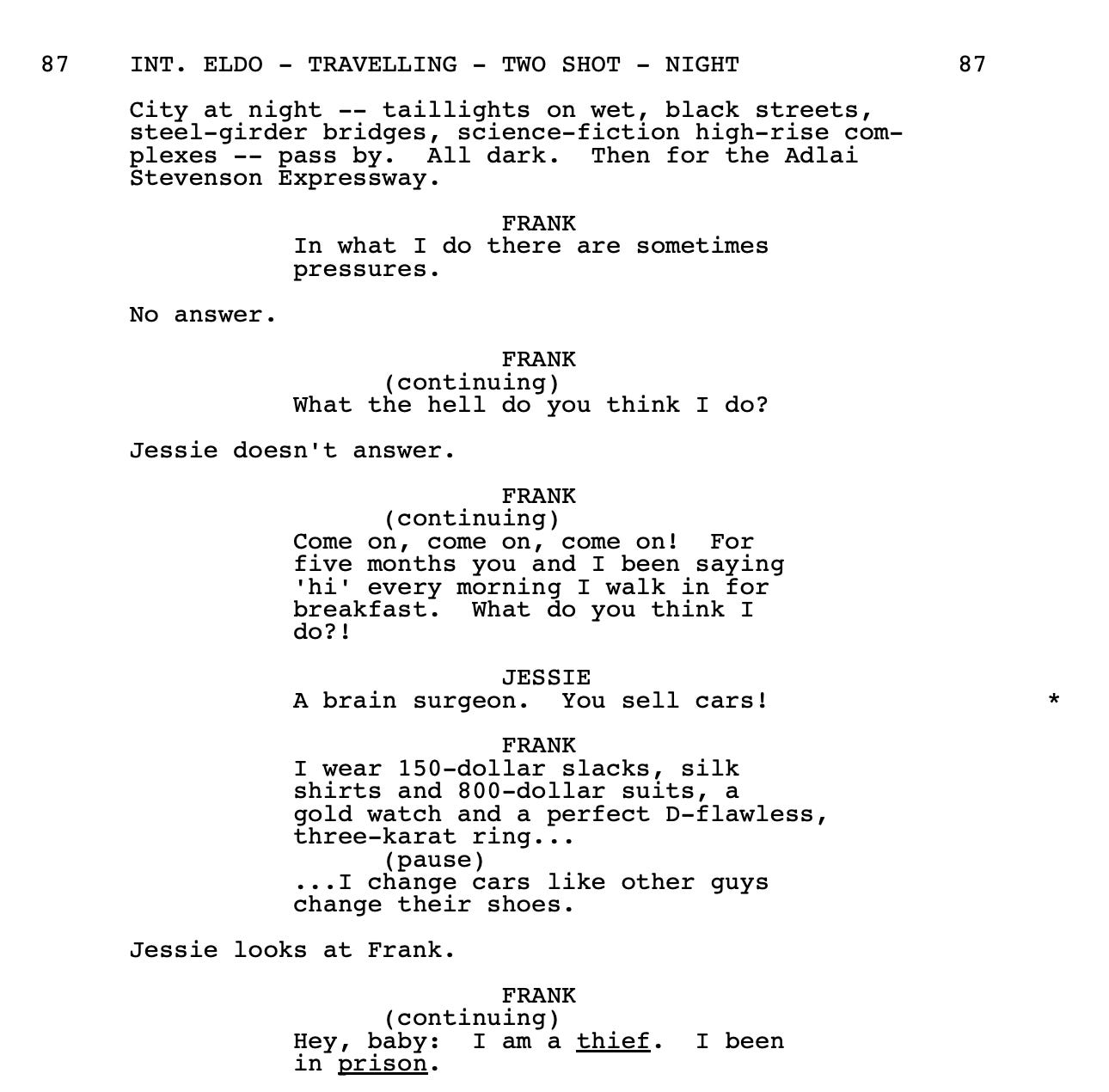
First, an argument in the car between Frank (James Caan) and Jessie (Tuesday Weld) in the car:
Which materialized in the film like this:
Step by step:
Jessie’s non-replys create a vacuum that needs to be filled
The pressure of Frank’s desire builds, begging for a reply
Jessie’s reply relieves some of this pressure momentarily
Frank crescendos for the signature “I’m a thief.” line
Jessie crescendos (a bit after this clip) saying “so what, I don’t care”
Pressure builds gradually until it erupts, an enormous change of charge in under a minute, under careful control. Two characters who talk past each other the whole film, Frank fundamentally unable to give Jessie what she wants, and Jessie unable to receive.
Thief (1981) — Meeting Leo
Another more lyrical scene, Frank meets Leo, a mob boss:
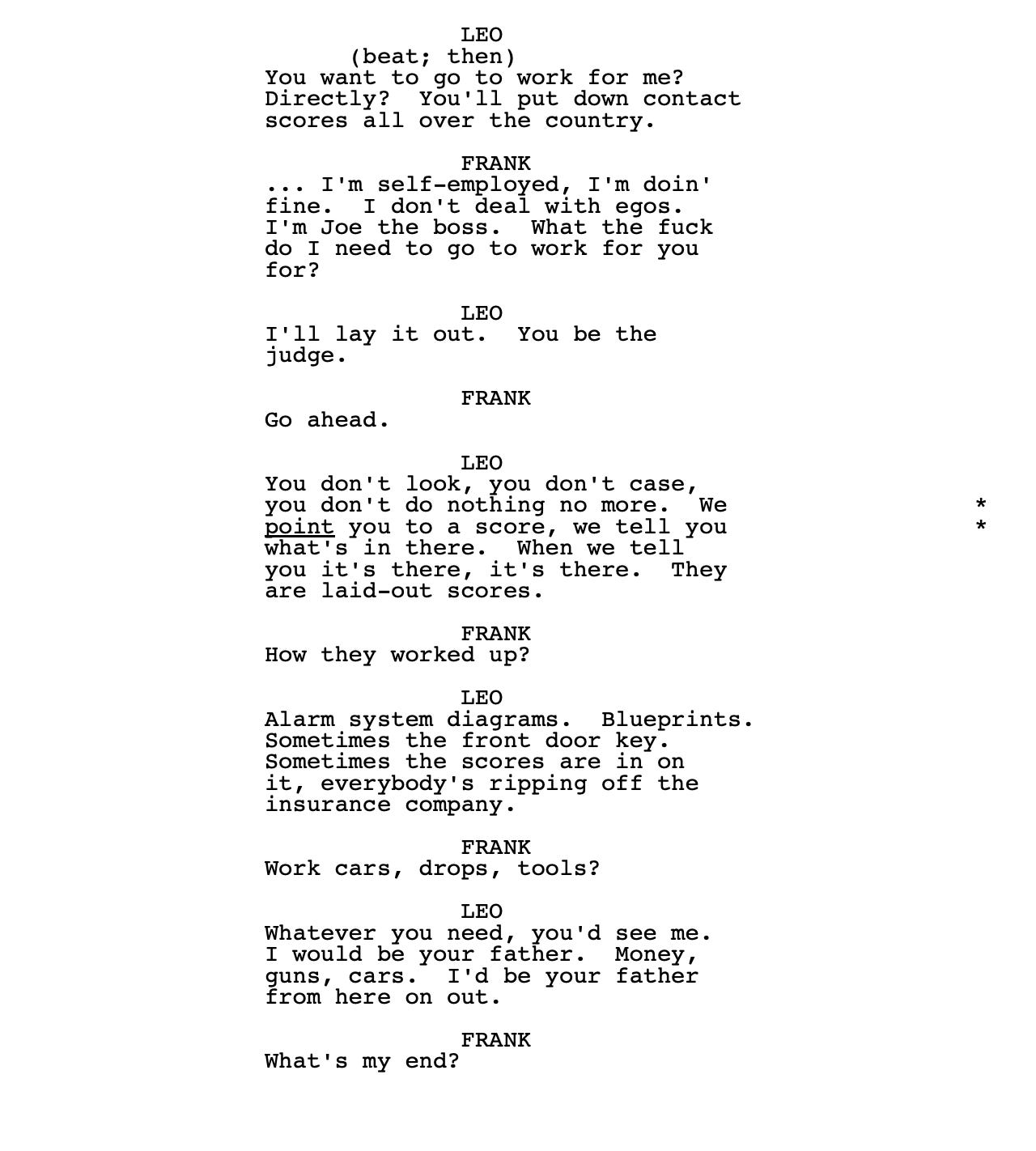
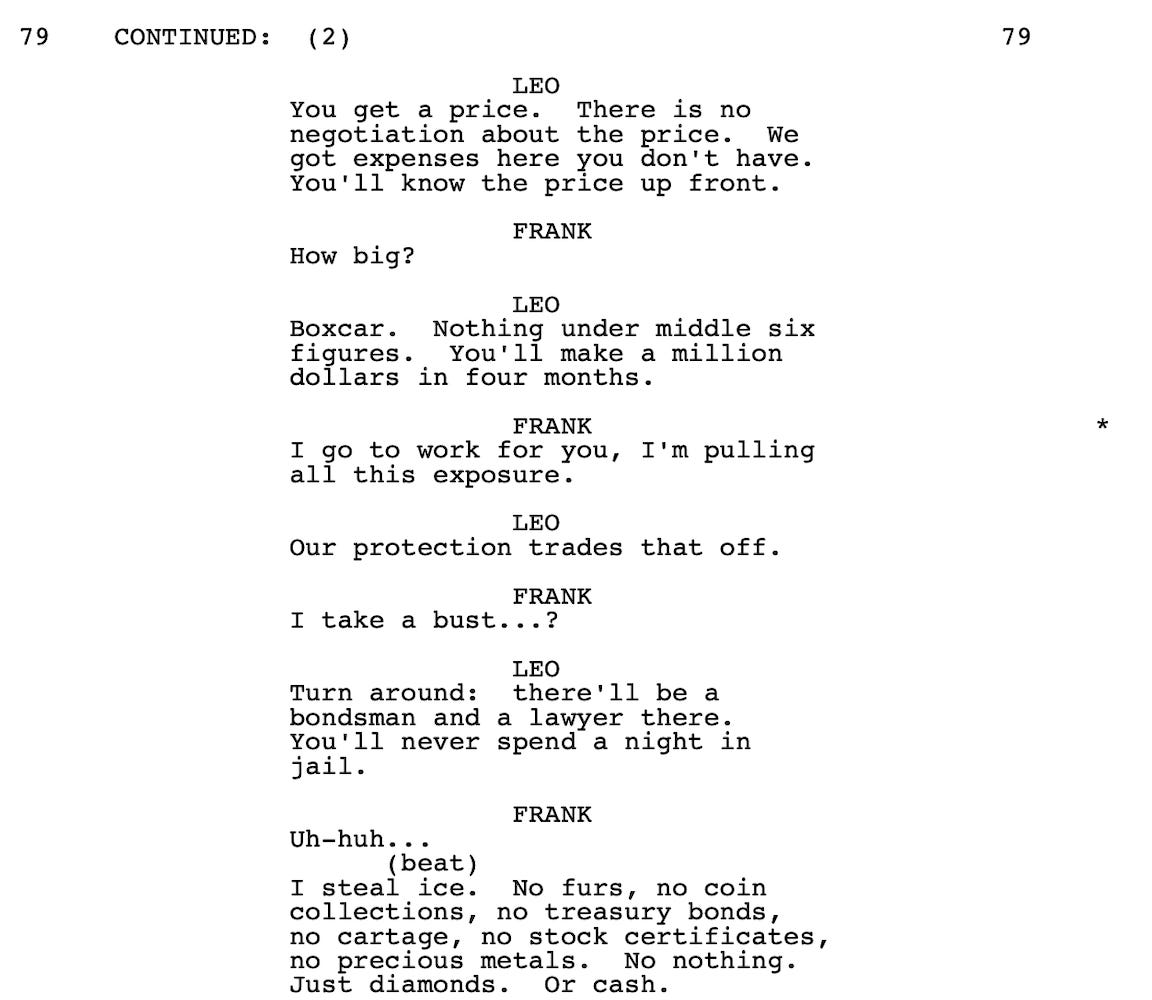
Which appears in the film like this:
The back-and-forth is much faster, pinging between the two, Leo with quick replies and Frank more measured and to himself. Despite speaking quietly, the emotional charge between the two is enormous. Leo is a dangerous person.
For a 3rd example there is the adoption agency scene which crescendos smoothly as well, but will omit for copyright purposes as it is a longer scene.
Heart
The last point I’ll touch on in detail is whether a script/film has “heart” behind it. Does the writer/director/crew have a personal stake in the story they are telling? Is something at risk, is there exposure in the telling of it? This may seem optional, but the best stories all have this. You cannot move an audience of strangers sitting in a dark room with no one telling them how to think or feel unless you put something profoundly true in front of them without hiding.
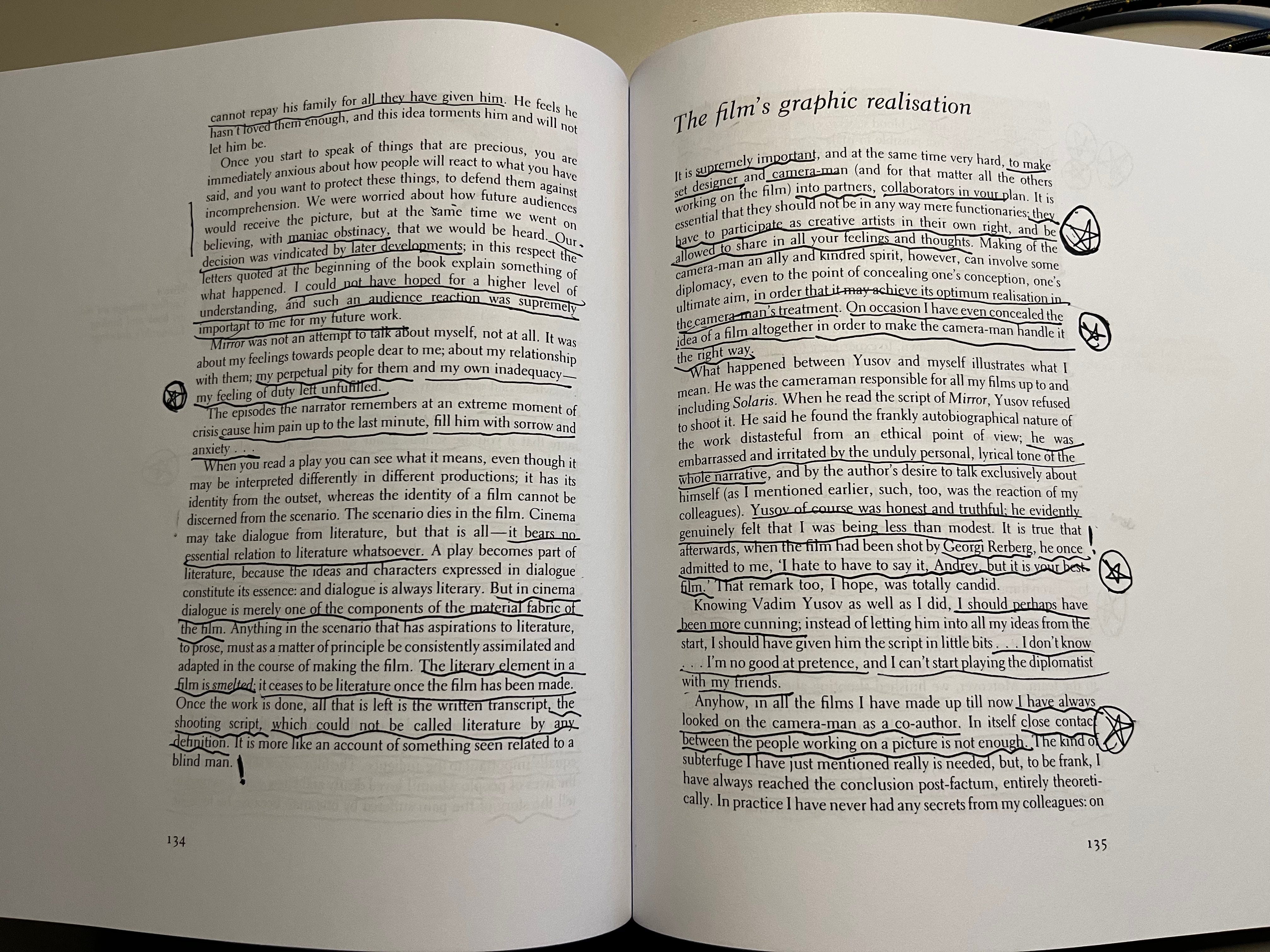
In his book “Sculpting in Time” Andrei Tarkovsky (one of the greatest directors of all time) writes:
… Artistic creation demands of the artist that he 'perish utterly', in the full, tragic sense of those words. And so, if art carries within it a hieroglyphic of absolute truth, this will always be an image of the world, made manifest in the work once and for all time. … These poetic revelations, each one valid and eternal, are evidence of man's capacity to recognise in whose image and likeness he is made, and to voice this recognition. Moreover, the great function of art is communication, since mutual understanding is a force to unite people, and the spirit of communion is one of the most important aspects of artistic creativity. — Andrei Tarkovsky, Sculpting in Time (pg. 39)
(continuing on…)
… Art is a meta-language, with the help of which people try to communicate with one another; to impart information about themselves and assimilate the experience of others. Again, this has to do not with practical advantage but with realising the idea of love, the meaning of which is in sacrifice: the very antithesis of pragmatism. I simply cannot believe that an artist can ever work only for the sake of 'self-expression'. Self-expression is meaningless unless it meets with a response. For the sake of creating a spiritual bond with others it can only be an agonising process, one that involves no practical gain: ultimately, it is an act of sacrifice. But surely it cannot be worth the effort merely for the sake of hearing one's own echo? — Andrei Tarkovsky, Sculpting in Time (pg. 40)(finally…)
… True artistic inspiration is always a torment for the artist, almost to the point of endangering his life. Its realisation is tantamount to a physical feat. That is the way it has always been, despite the popular misconception that pretty well all we do is tell stories that are as old as the world, appearing in front of the public like old grannies with scarves on our heads and our knitting in our hands to tell them all sorts of tales in order to keep them amused. The tale may be entertaining or enthralling, but will do only one thing for the audience: help them pass the time in idle chatter. — Andrei Tarkovsky, Sculpting in Time (pg. 188)
Looking back on it, I aggressively underlined almost every sentence in the book, it’s just that good (and I’m not aware of any other book that contains a stream of thought so detailed from such a prominent director in history, it was written while Tarkovsky was on exile from the USSR in Italy, Sweden, and France between 1982-1985).
Rosetta (1999) — Whispering Hope
I’ve recently started going through the Dardenne brothers filmography (Luc Dardenne and Jean-Pierre Dardenne), and recently watched a film I really enjoyed called Rosetta (1999).
In it, a desperate teenage girl claws her way through dead-end jobs in a deindustrialized Belgian town, dragging her alcoholic mother along with her. The Dardennes made it from the inside, from years of documenting working-class Belgium, and you feel that weight in every frame.
The most moving scene in the film happens when Riquet, a waffle wagon worker who becomes Rosetta’s only real human connection, lets her sleep on his cot in a spare unit:
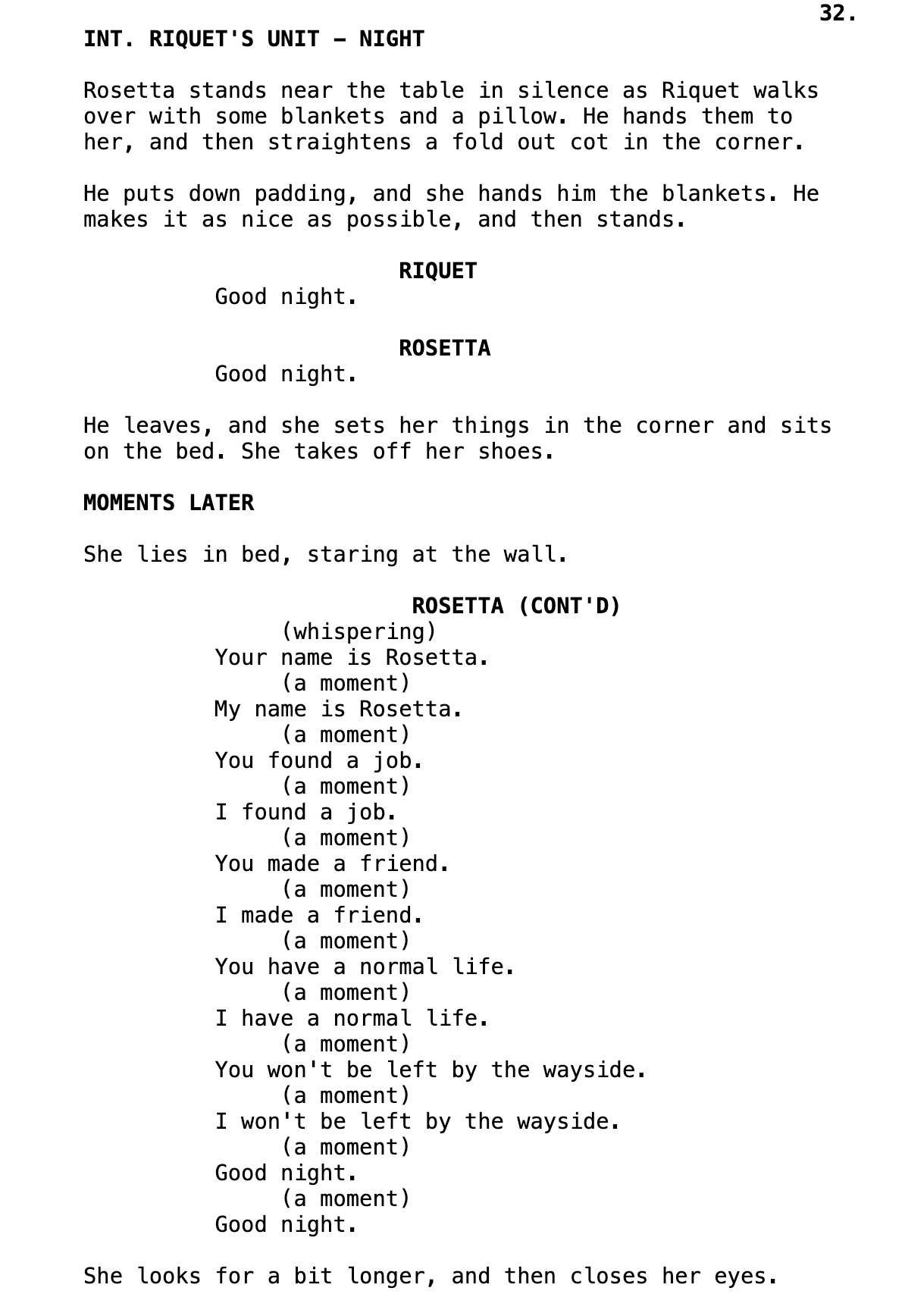
Which appears in the film as this:
There is a claustrophobia to the space and an intimacy to seeing someone chant encouragement to themselves in bed. It’s the character at full exposure, and the audience has seen enough of her getting abused to fully embrace her as themselves.
The best films aren’t trying to make a point, they’re trying to make someone, or some circumstance in the world, seen — in such a way that people can find themselves in the characters. This requires a connection to the material that is personal, so you can reach the personal in others.
This is the core reason why cinematic storytelling on the technology industry is non-existent. Aside from a massive creative labor shortage & enormous financial incentives pulling creative talent away — it requires direct contact to human experience without abstracting it into frameworks or meaning. The people with access to the experience can’t hold it raw. The people who can hold experience raw don’t have access.
The Rest
I won’t belabor the rest of the points, so quickly:
Strong Character Identity: Read The Breakfast Club (1985), it will teach you everything you need about cast design. Every character forms around a distinct archetype found in high schools that everyone can relate to (jock, academic, outcast, badboy, pretty girl). Great cast design has individual and highly functional characters. This leads to strong identities where characters don’t sound like they could be “anyone,” they sound like real people.
Through specificity, the story becomes about much more than high school. It becomes about the search for identity in youth, the struggle against authority, performance of identity under social pressure, parental damage, and the limits of empathy.
Formatting: If you scroll this article, you will see portions where your reading slows down, and you have to pay more attention (like the 14-point bullet section) and portions where you can fast scroll past (the video samples). The same goes for reading, when dialog exchanges thin out and go vertical on the page, your eyes speed up, and the image speeds up. Thick walls of action lines slow you down and force environmental context to get built. Same goes for dialog. Whiplash (2014) is a good script to study for format and character economy.
Vivid Emotional Awareness: Similar to tonal control but focused on character motivations and internal states instead of watcher experience. Is the writer writing from inside their character’s deepest fears and wants? You’ll be able to sense it.
Control of Pace: Stories speed up and become more intense as they near the ending. Pace is accelerated. “Speed up” doesn’t necessarily mean frantic action or faster events (it can mean that); it just means more happens within the characters and with more charge, such that reading speed quickens and the reader is eager to reach the end. Paul Thomas Anderson does this well across acts (see Magnolia 1999).
Premise & Originality, Axes of Conflict: Many indie films I watch have a single axis of conflict and a weak premise. Just because it happened in your life and it generalizes to others, doesn’t make it a good story (i.e. family issues, childhood memories). These stories can work, but the characters just need to be compelling, performance compelling, something has to be different about them. If the chart of character conflict is just 2 bubbles and 1 line, or 4 bubbles and 2 lines, the story isn’t good.
Strong Opening & Ending: See Whiplash (2014), Kill Bill: Vol. 1 (2003) (or any Tarantino film), Anora (2024), Y Tu Mamá También (2001), endlessly many more
Writing Better Films on Tech
I just wanted to write a post to collect my thoughts on a criterion that had been invisible to me until writing this, and that I will use for SVFF’s first cycle while reading. It is also the measuring stick I use to assess story quality for non-scripted stories (documentary, social content, etc).
So when I say “we need better stories” I’m running through the tech film canon, which contains nearly 0 films from the interior, and thinking point by point. What is the quality of the stories (cinema) made from inside this culture? And the problem is, there are few to even assess quality on.